
Beginning

I am a gourmand, not a gourmet, a food lover, not a food snob.
I hope to share my love of food with you through narratives, restaurant recaps,
menu suggestions, and recipes. Bon appetit!
(And if you blog about food, are you "flogging"?)

Sunday, October 20, 2013

Oktoberfest Wieder (Again)

October is a beautiful month.  In northern Wisconsin, my home state, it means the riotous colors of the changing leaves.  Even when they fall to the ground, you can enjoy the smoky smell and delightful crunching as you walk through what I like to call “God’s confetti.”
In Louisiana, my adopted state, October means temperatures might “dip” into the 70s during the day, necessitating the occasional sweater.
October also means Oktoberfest in Germany and in many places around the world.  And so I thought a German meal would be perfect for entertaining some dear friends.  (This was one of several Oktoberfest-themed dinner parties we’ve hosted, and the second of my Oktoberfest blog posts.  See Remembering October(fest), January 2011.)
Actually, an Oktoberfest was the beginning of a family near and dear to me.   In October 1954 in a crowded Munich beer garden, a young American G.I. met a young German woman who had recently escaped from East Germany.  The festive flirtation led to a courtship, a marriage, and the birth of my husband and his brother. 
This May my dear mother-in-law passed away, so in my heart this dinner party was in her honor.  Auf wiedersehen, Ruth!  Until we see each other again.

Oktoberfest Menu

Onion Tart
Sauerkraut Soup
German Cucumber Salad
Ruth's Beef Rouladen
Spaetzle
Ruth's Red Cabbage
Pear Upside-down Cake

Onion Tart

Source:  Pepperidge Farm web site

Yield:  6-8 servings

Ingredients:

2 T. vegetable oil
1 large sweet onion, thinly sliced (I used 2)
All-purpose flour
½ of a 17.3-ounce package Pepperidge Farm Puff Pastry Sheets (1 sheet), thawed
1½ c. shredded Gruyère cheese  (about 6 oz.) (can substitute Emmental and/or Swiss or a combination of any of these)
¼ c. grated Parmesan cheese
2 T. chopped fresh chives (I used thyme)

Process:

Heat the oven to 400°F.  Line a baking sheet with parchment paper.  Heat the oil in a 12-inch skillet over medium heat. Add the onion and cook for 15 minutes or until well browned, stirring often.  Remove the skillet from the heat and let cool to room temperature.

Sprinkle the work surface with the flour.  Unfold the pastry sheet on the work surface.  Roll the pastry sheet into a 12-inch square.  Place the pastry onto the baking sheet.  Brush the edges of the pastry with water. Fold over the edges 1/2 inch on all sides, crimping with a fork to form a rim.  Prick the center of the pastry thoroughly with a fork.  Spread the onion mixture on the pastry to the rim.  Sprinkle with the cheeses and chives or thyme.

Bake for 20 minutes or until the pastry is golden brown.  Let the pastry cool on the baking sheet on a wire rack for 5 minutes. Cut into 24 (3x2-inch) rectangles.  Serve warm.

Sauerkraut Soup

Source:  adapted from The German Cookbook, Mimi Sheraton

Yield: 6 to 8 servings

Ingredients:

3 slices bacon, diced
1 lb. fresh sauerkraut, rinsed, drained, chopped (I used jarred)
1 onion, peeled and finely diced
1 T. flour
6 c. hot beef stock 
1 c. dark beer (or 1 c. stock)
1 small apple, peeled and grated
1-2 tsp. caraway seeds
Salt to taste

Optional garnish per serving:

1 piece of pumpernickel bread (cut in a round with biscuit cutter)
¼ c. grated Gruyére (or Swiss) cheese

Fry diced bacon in a 1½- to 2-quart saucepan and when rendered, sauté sauerkraut and onion in hot fat until they begin to take on color.  Sprinkle with flour and stir together, add hot beef stock, beer, grated apple, caraway seeds and salt.  Simmer, covered, 20 minutes.  

For the garnish:  Place the bread rounds on a parchment-lined baking sheet and heat in a 350° until lightly toasted.  Sprinkle the cheese on each piece of bread and return to the oven until the cheese melts.  Float a bread round in each bowl of soup.

German Cucumber Salad

Source:  someone posted this in Facebook 

Yield:  6-8 small servings

Ingredients:

Salad:

2 large cucumbers, peeled and thinly sliced
1 small onion, peeled and thinly sliced
3 small roma tomatoes, thinly sliced

Dressing:

1/3 cup low-fat sour cream
¼ tsp. Dijon mustard
1 T. white vinegar
2 T. low-fat milk
½ - ¾ tsp. sugar
1 T. chopped fresh parsley
2 T. chopped fresh dill
¼ tsp. pepper
¼ tsp. salt, to taste

Process:

Place the cucumbers, onions and tomatoes in a large bowl. Set aside.  In a small bowl, whisk together all dressing ingredients. Pour over salad mixture.  Toss to coat well.  Chill at least 2 hours before serving.  I served individual portions on small beds of mixed greens.

Ruth’s Beef Rouladen

The key to this is dish is . . . the butcher!  My husband was able to find one who expertly cut the meat to our exact specifications.  

Source:  my mother-in-law, Ruth Demastes

Ingredients:

Top round or sirloin tip cut in pieces approximately 6 in. X 10 in. and ¼ in. or less thick (2 pieces per person)
Salt & pepper
Dijon mustard
Bacon strips cut in half
1 onion, peeled, cut in 
Dill pickles, cut in half crosswise, and then in ½-inch pieces
Water and 2 bouillon  cubes (or beef stock), about 2½ c.
Cornstarch or flour

Process:

For each roulade:  Lightly salt and pepper the piece of meat.  Spread each piece of meat with a teaspoon of mustard.  Near one edge of each piece, place a strip of bacon, a few pieces of onion, and a piece of pickle. Roll up jelly-roll fashion and secure with a toothpick.  
Ready to roll
All rolled up


Heat the oil in a large pot or frying pan over medium heat.   Add the meat rolls and brown well on all sides. Reduce the heat to low, and add the water and bouillon cubes (or beef stock).  (The liquid should not cover the meat.)  Simmer until the meat is tender, about 1 to 1½ hours.  Remove the meat and cover.  To thicken the sauce, stir a tablespoon or so of cornstarch to ½ c. water.  Whisk a little of the cornstarch mixture into the sauce until it thickens.  (Alternatively, remove a cup of hot liquid and combine with 2 T. flour.   Stir back into pan and cook, stirring, until it comes to a boil and thickens.)  Add rolls to sauce and reheat gently.  

Spaetzle 

Source:  from my mother-in-law via my sister-in-law, Theresa Spradling (who saved me when I inexplicably lost MY recipe in the middle of dinner party preparations)

Yield:  6 servings

2 c. flour
2 tsp. salt
¼ tsp. pepper 
1/8 tsp. nutmeg
¼ c. milk
½ c. water (I used ¾ c. milk)
3 eggs, slightly beaten

In a large bowl which together the dry ingredients.  In a small bowl, whisk together the liquid ingredients. Stir the liquid ingredients until blended.  The batter will be very sticky.  Push the batter through a spaetzle maker into a large pot of boiling water.  As the spaetzle come to the surface, remove with a slotted spoon.  
A spaetzle maker

Alternatively, you can push the spaetzle batter through the holes of a colander.  The spaetzle can be made slightly ahead of time.  Stir in a tablespoon of butter to prevent sticking and keep in a covered casserole dish. Reheat in the microwave if necessary.
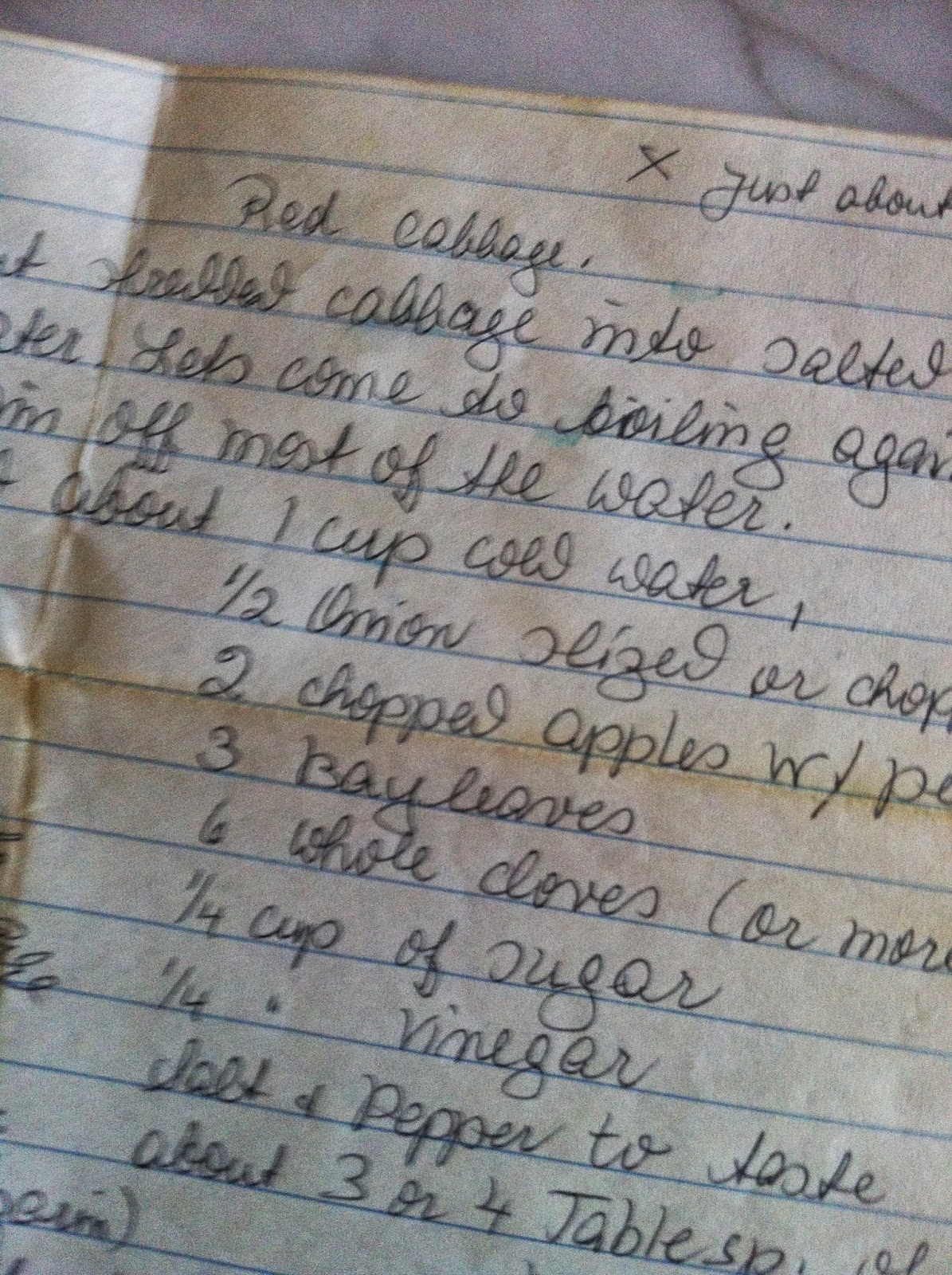

Ruth’s Red Cabbage

The first time I made this I was terrified I had done something wrong since the cabbage turns navy blue in the initial cooking stage.  But don’t worry.  As soon as the other ingredients are added, the cabbage returns to beautiful pinkish red.
Blue red cabbage!
Red red cabbage

Source:  my mother-in-law, Ruth Demastes

Yield:  8 servings

Process:

1 red cabbage, hand chopped 
½ onion, sliced or chopped
2 chopped apples, cored but not peeled
3 bay leaves
6 whole cloves
¼ c. sugar
¼ c. vinegar
Salt & pepper to taste
3-4 T. of bacon drippings (I add the bacon as well)

Process:

Put the cabbage into a large pot of salted boiling water.  Let the water come to a boil again, about 1 minute. Drain off most of the water.  Then add one cup of cold water and the remaining ingredients.  Cook all this at low temperature with the lid slightly open until tender, about an hour.  Check once in a while and add a little water if necessary.  (But you don’t want a lot of liquid.)  At the end of the cooking, you can blend 2 T. cornstarch with a little cold water and stir into cabbage just to thicken the liquid.  
Pear Upside-Down Cake

Source: Family Circle, Nov. 2013

Yield:  8-10 servings

2 T. cold unsalted butter
½ c. packed dark brown sugar
2 Bartlett pears, (about 1 lb.), peeled, cored and thinly sliced
2 c. all-purpose flour
1 t. ground ginger
2 t. baking powder
½ t. salt
½ t. ground cardamom
½ c. (1 stick) unsalted butter, softened
1 c. granulated sugar
2 large eggs
1 t. vanilla extract
2/3 c. milk
Whipped & sweetened cream or ice cream (optional)

Process:

Preheat oven to 350°.  Add cold butter to a 10-inch springform pan.  Heat in oven until melted, about 3 minutes.  Swirl pan to coat bottom with melted butter.  Sprinkle evenly with brown sugar.  Wrap bottom of pan with foil. Fan slices of pear over sugar, with pointed ends toward center of pan, overlapping slightly.  Set aside.

In a small bowl, whisk together flour, ginger, baking powder, salt and cardamom.  With a stand mixer, beat softened butter in a large bowl until smooth.  Add granulated sugar and beat 2 minutes, until creamy.  Beat in eggs, one at a time, beating well after each addition.  Beat in vanilla.

On low speed, beat in flour mixture, alternating with milk, beginning and ending with flour mixture.  Spoon batter over pears and spread to pan edge with a spatula.  Bake for 55 to 60 minutes.  Test center of cake with a toothpick; if pick tests clean, remove to a wire rack.  Cool 5 minutes.

Invert cake onto plate, remove side of pan.  Carefully lift off pan bottom and cool cake to room temperature. Serve slightly warm with whipped cream or ice cream, if desired.


Monday, August 5, 2013

Grand Dames & Prostitutes

Galatoire’s Restaurant, located at 209 Bourbon Street in New Orleans, is, as their website states, a “grand dame” of New Orleans cuisine.  If that title reminds you of the persnickety and somewhat crotchety Dowager Countess on Downton Abbey, you wouldn’t be far off in some ways.

Until recently, Galatoire’s did not take reservations, and men must still wear jackets after 5 p.m.  For my daughter’s 21st birthday, we stood in line for over an hour on a week night for, I’m sorry to say, a very overpriced and mediocre meal served by an overly imperious waiter.   But the meal did come with a wonderful sense of tradition and history.

Recently, Galatoire’s opened a restaurant in Baton Rouge, Galatoire’s Bistro, located at 3535 Perkins Road.

Actually this is the second incarnation of the "grand dame's" heir.  We never ate at the first Galatoire's in Baton Rouge, but this new
establishment seems to be well-received especially by the "ladies who lunch" crowd.

I've eaten lunch twice here, and their $19.05 (the price reflects the year the original Galatoire's opened) three-course lunch is a tasty bargain. But while the  "snob" factor is missing here--it is a bistro, after all--there are aspects of the atmosphere which are very off-putting.

It’s clear that the décor of Galatoire’s Bistro is intended to replicate the Old World atmosphere of its New Orleans counterpart with its huge dining room, mirrored walls and floor covered in one-inch white octagonal tiles.  The result, however, is a light, bright acoustic nightmare. 

Eating outside in their courtyard, weather permitting, is more conducive to conversation, but I can’t for the life of me figure out why they put this al fresco space in front of the restaurant on busy Perkins Road instead of in the quieter back portion of the restaurant’s lot.

That being said, the food is quite good.  Recently, my husband and I had dinner at Galatoire’s.  While we were hard-pressed to find a bottle of wine under $40 dollars, my husband loved his veal liver.

And I had perhaps one of the best fish dishes I've had in years—the Grilled Gulf Provençal.  This was mahi mahi served over roasted roma tomatoes, red onion, kalamata olives, capers, and fresh basil.

As an added bonus to this great meal, we were actually able to hear ourselves talk because it wasn’t very crowded on this weekday night.

Here is a dish that comes close to the dish I had at Galatoire's Bistro.  “Alla Puttanesca” literally means “in the style of a whore.”  My guess is that ladies of the evening didn't have a lot of time to attend to a slow-cooked spaghetti sauce.

Tilapia alla Puttanesca

Source:  adapted from a Better Homes & Gardens recipe

Yield:  4 servings

1 lb. fresh or frozen skinless tilapia fillets
1 onion, halved lengthwise, and sliced into thin slices crosswise
1 T. olive oil
2 cloves garlic, minced
1 (14.5-oz.) can diced tomatoes, undrained
½ c. chicken broth
1 T. tomato paste
½ t. each of dried oregano, basil and thyme, crushed
¼ t. crushed red pepper
½ c. chopped pitted Kalamata olives
1 T. capers, drained
2 T. coarsely chopped fresh Italian parsley or basil

Thaw fish, if frozen.  Rinse; pat dry with paper towels.  Set aside.

In a large skillet, cook onion in olive oil over low heat 20-30 minutes or until tender and deeply caramelized.  Stir in garlic, and cook for 30 seconds.    Add tomatoes, chicken broth, tomato paste, herbs and crushed red pepper.  Bring to boiling; reduce heat.  Simmer, uncovered, 5 minutes.

Add olives and capers to sauce.  Top with tilapia fillets.  Return  sauce to boiling; reduce heat.  Cook, covered, 6 to 10 minutes or until fish flakes when tested with fork.  Remove fish.  Simmer sauce, uncovered, 1 to 2 minutes more to thicken. 

To serve, spoon sauce over fish.  Sprinkle with parsley or basil.  Serve with rice, pasta, couscous or quinoa.  

Sunday, April 21, 2013

It's Greek to Me!


Is there anything more wonderful than plucking a sprig of rosemary from a bush and rubbing it between your thumb and forefinger?  That redolent smell lingers and lingers. 

I think one of the things I love the most about Greek food is the herbs:  oregano, mint, basil, dill, and, of course, rosemary.   Add lemons, fennel, cinnamon, garlic—ingredients that are as aromatic as they are delicious--and every course in a Greek meal is like taste-bud "perfume."  

With all those fresh flavors, a Greek menu seemed especially appropriate for spring.  (My sympathies are with all my northern relatives who are still struggling under snow—in April!). 

And spring with all its harbingers of new life seemed an especially appropriate time to celebrate a dear friend’s successful cancer treatment and his recent marriage to a wonderful woman! 

Rosemary Napkin Rings

To make the dinner party a bit more festive, I made rosemary napkins.  I cut 6-inch pieces of rosemary from our outside bushes, and stripped the bottom half of the leaves from the stem. 

I rolled each folded napkin into a cylinder and then tied the rosemary stem around the center of the cylinder.

Greek Menu

Rosemary Cashews
Purchased mixed Greek olives
Greek Spinach-and-Cheese Pastries with Tzatziki Sauce
Chilled and Dilled Avgolemeno Soup
Roasted Shrimp with Feta
Orzo with Everything
Sautéed Vegetable Strips
Lemon Torta


Rosemary Cashews

In her recipe, Garten toasts the cashews first then tosses them with the warm butter mixture.  I roast the cashews after coating them with the butter mixture.  Also, since I can never find unsalted cashews (in her original recipe), I use salted and add no extra salt.  I think Ina likes salt more than I do!

Source:  adapted from a recipe by Ina Garten

Ingredients:

1 pound roasted, salted cashews
2 T. chopped fresh rosemary leaves
¼ to ½ tsp. cayenne pepper
2 tsp. brown sugar
1 T. unsalted butter, melted

Process:

Preheat the oven to 350°.  In a medium bowl, mix the spices, sugar and butter.  Add the cashews and mix to coat.  Spread the cashews out on a sheet pan.  Roast in the oven until warm, about 7-10 minutes.  Serve warm if possible, but they taste great at room temperature. Refrigerate leftovers.


Greek Spinach-and-Cheese Pastries

Source:  an old clipping from Southern Living

Yield:  5½ dozen

2 (10-oz.) packages frozen chopped spinach, thawed and drained
2 large eggs
 2 c. (8 oz.) shredded sharp Cheddar cheese
1 c. (4 oz.) crumbled feta cheese
¾ c. thinly sliced green onions
1 ½ T. dried or ½ c. chopped fresh dill weed
½ c. chopped fresh Italian parsley
½ t. salt
¼ t. pepper
1 (16-oz.) package frozen phyllo pastry (22 sheets), thawed
Vegetable cooking spray

Combine first 9 ingredients in a large bowl; set aside.  Unfold phyllo, and cover with a slightly damp towel to prevent pastry from drying out.  Place 1 sheet of phyllo on a flat surface covered with wax paper; coat with cooking spray.  Top with another sheet of phyllo; coat with cooking spray.  Cut crosswise into 4 strips.

Place 1 T. spinach mixture at base of each strip; fold the right bottom corner over to form a triangle.  Continue folding back and forth into a triangle (like a falt) , gently pressing corners together.

Place triangles, seam side down, on ungreased baking sheets; coat triangles lightly with cooking spray.  Repeat procedure with remaining phyllo sheets, cooking spray, and spinach mixture.

Bake pastries at 350 for 12 to 14 minutes or until golden.  Serve immediately.

Note:  Unbaked appetizers may be frozen up to 2 weeks.  Freeze on baking sheets until hard; then freeze in airtight containers.  Bake, unthawed, as directed above.

Tzatziki

Source:  Epicurious, Sept. 2012

Yield:  2 cups

Ingredients:

1 English cucumbers, peeled, seeded, and shredded
Kosher salt
1½  cups plain nonfat yogurt
1 T. white wine vinegar
1 cloves garlic, peeled and finely chopped
1 T. dried mint
6 to 7 leaves fresh mint, thinly sliced
Freshly ground black pepper

Process:

Place the shredded cucumbers in a medium bowl and toss with a few pinches of salt. Set aside for 15 minutes to draw some of the liquid out of the cucumbers.
Drain the excess liquid from the bowl of cucumbers. Add in the yogurt, vinegar, garlic, dried mint, and fresh mint. Mix well to combine. Adjust the seasoning as needed with salt and pepper. Refrigerate until ready to serve.

Chilled and Dilled Avgolemono Soup

Source:  Gourmet, July 2009

Yield:  4 servings

Ingredients:

4 cups chicken stock, or 3 cups reduced-sodium chicken broth plus 1 cup water
¼ c. long-grain white rice
2 large eggs
3 T. fresh lemon juice
1 scallion green, thinly sliced
2 T. chopped fresh dill

Simmer stock and rice in a heavy medium saucepan, covered, until rice is very tender, about 30 minutes. Purée mixture in a blender (use caution when blending hot liquids). Whisk eggs together in a medium bowl. Gradually whisk in hot stock mixture. Return to saucepan and cook over medium heat, stirring constantly with a wooden spoon, until soup registers 170°F on an instant-read thermometer.

Strain soup through a fine-mesh sieve into a metal bowl. Stir in lemon juice, then quick-chill in an ice bath, stirring occasionally, until cold. Stir in scallion, dill, and salt and pepper to taste.  (Soup can be made 2 days ahead and chilled.)

Roasted Shrimp with Feta


I doubled this recipe and baked it in a very large gratin dish, keeping the shrimp in a single layer. 

Source:  Ina Garten’s How Easy is That

Serves:  4 

Ingredients:

4 T. good olive oil, divided
1½ c. medium-diced fennel
1 T. minced garlic (3 cloves)
¼ c. dry white wine
1 (14 1/2-ounce) can diced tomatoes
2 tsp. tomato paste
1 tsp. dried oregano
1 T. Pernod (I used Ouzo)
1 tsp. kosher salt  (I used half)
½ tsp. freshly ground black pepper
1¼ pounds (16 to 20 per pound) peeled shrimp with tails on
5 ounces good feta cheese, coarsely crumbled
1 c. fresh bread crumbs (I "whirred" 4 slices of crustless bread in the fod processor.)
3 T. minced fresh parsley
1 tsp. grated lemon zest
2 lemons

Process:

Preheat oven to 400°.  Heat 2 T. of the olive oil in a 10-or 12-inch heavy ovenproof skillet over medium-low heat. Add the fennel and sauté for 8 to 10 minutes, until the fennel is tender. Add the garlic and cook for 1 minute. Add the wine and bring to a boil, scraping up any browned bits. Cook for 2 to 3 minutes, until the liquid is reduced by half. Add the tomatoes with the liquid, tomato paste, oregano, Pernod, salt, and pepper to the skillet. Simmer over medium-low heat, stirring occasionally, for 10 to 15 minutes.

Arrange the shrimp, tails up, in one layer over the tomato-mixture in the skillet. Scatter the feta evenly over the shrimp. In a small bowl, combine the bread crumbs, parsley, and lemon zest with the remaining 2 T. of olive oil and sprinkle over the shrimp.

Bake for 15 minutes, until the shrimp are cooked and the bread crumbs are golden brown. Squeeze the juice of 1 lemon over the shrimp. Serve hot with the remaining lemon cut into wedges.  Perhaps because I doubled it, it took about 30 minutes for the shrimp to be done.

Orzo with Everything

Source:  Bon Appétit, July 1998

Yield:  serves 6

Ingredients:

1 ½ c. orzo (rice-shaped pasta; about 10 ounces)
1/3 c. (packed) chopped drained oil-packed sun-dried tomatoes
5 tablespoons extra-virgin olive oil
¼ c. balsamic vinegar
¼ c. (packed) chopped Kalamata olives or other brine-cured black olives
1 c. finely chopped radicchio (about 1 small head)
½ c. pine nuts, toasted
½ c. chopped fresh basil
½ c. freshly grated Parmesan cheese
2 large garlic cloves, minced

Process:

Cook orzo in pot of boiling salted water until just tender but still firm to bite. Drain well. Transfer to large bowl. Add sun-dried tomatoes, oil, vinegar and olives and toss to blend. Let stand until cool. (Can be prepared 6 hours ahead. Cover and refrigerate. Bring to room temperature before continuing.)   Mix chopped radicchio, pine nuts, chopped basil, Parmesan and garlic into orzo mixture. Season salad to taste with salt and pepper and serve.

Sautéed Vegetable Strips

Source:  Kay Ewing’s Cooking School Cookbook

Yield:  6 servings

2 carrots, peeled                                          
2 zucchini, scrubbed                      
2 yellow squash, scrubbed
2 T. butter
Salt & pepper to taste

Cut vegetables in strips with a vegetable peeler (don’t include seeds).  Melt butter in a skillet over medium-high heat.  Sauté vegetable strips about 1 minute, just to heat.  (I sautéed the vegetables a little longer until tender and Salt & pepper and serve immediately.

Yield:  6 servings

Lemon Torta
Source:  Kay Ewing’s Cooking School Cookbook
Crust:

¼ c. butter
1 ½ oz. cream cheese
2/3 c. flour
½ tsp. sugar

Preheat oven to 350.  Cut up butter and cream cheese into a food processor and add flour and sugar.  Process just until mixture forms a ball.  Remove and roll out on a lightly floured surface. (I didn’t roll it out; I just pressed it into the pan). Press dough into the bottom and up the sides of a greased 9” shallow tart pan with a removable bottom.
Filling:
2 eggs
3 T. melted butter
3 T. lemon juice
2/3 c. sugar
Powdered sugar
Whipped cream
Lemon zest for garnish

Place eggs, butter, lemon juice and sugar in a food processor (Don’t bother to clean it out from the crust step) and process for about 30 seconds.  Pour filling into crust and bake for about 30-35 minutes until golden brown.  Cool completely and chill.  (I didn’t chill it, and I made it the day ahead—both seem fine.)  Before serving, sprinkle torta with powdered sugar.  Serve each slice with a dab of whipped cream and lemon zest for garnish
.

Thursday, January 3, 2013

Not So Lucky at Lüke


We knew it wasn’t John Besh’s flagship restaurant August.  We knew it was New Year’s Day, probably not the best day for a good dining experience.  Nevertheless, we expected so much more from Lüke.

Located at 333 St. Charles in the Hilton Hotel, Lüke's bright, bustling atmosphere WAS exactly what we expected.  The crowd seemed, unlike us, young and hip.  We had made reservations and only had to wait a few minutes before being shown to our table which had a view of the glassed-in kitchen.  I love watching the cooks in action!  The ambience was very European bistro.

A personal aside about “bistro” atmosphere:  When we took our daughter to restaurants when she was young, we were adamant that she not be one of those obnoxious kids who can’t stay seated or quiet.  So my husband told her that she could be more noisy if the restaurant was a “bistro,” but if it wasn’t, she had to be quiet and well-mannered.  So whenever we entered a restaurant, she would turn to my husband and ask, “Daddy, is this a bistro?”  Mostly he shook his head and replied, somewhat resignedly, “No.”   Our daughter would heave a small sigh but behaved like a “big girl,” seated nicely in her chair occupying herself with the colors and coloring book I always kept in my purse.  When we did dine at a “bistro,” such as Picadilly,a buffet restaurant, or McDonald’s, she still was well-behaved, although a little more enthusiastic.

Back to Lüke. 

Our server took our drink order.  We ordered a Malbec which wasn’t the cheapest wine on the list, but on the lower end of the wine menu.  Now I am no wine connoisseur, and I know that good wines can come with screw-off tops, but when you’re out for dinner it’s a little deflating to not get a cork to sniff. 


Our waiter brought our wine with some small baguettes and took our food order, and that is the last we saw of her until the end of our meal--too late to tell her we were served a Merlot instead of a Malbec and too late to tell her how our food tasted.  More about that later. 

For an appetizer, we ordered the Paté de Campagne, a rustic pork paté with a texture somewhere between a sausage and meatloaf.  The paté came with some slender crostini and a cutting board with dollops of a pepperonata (sautéed peppers, onion, and garlic), bread and butter pickles, pickled watermelon, and stone-ground mustard.  The pate was also garnished with a riesling gelée and (perhaps) some radish shoots.  Very delicious.

For his entrée, my husband ordered the Tuesday night special which is the “Maultaschen.” This was a piece of braised veal rolled in a sheet pasta, sliced in roulades, then flash-fried  and topped with a sweetish creole tomato sauce which had a nice basil-garlic flavor.  He was very pleased with his choice. 

I, however, was not so lucky in my entrée choice.  I ordered the jägerschnitzel which was described on the menu as “panéed veal, mushrooms, spätzle, warm porcini aioli.”   I have had a lot of jägerschnitzel, and I don’t mind a bit of “chew” to my veal, but this was a lot more deep-fried than pan-fried.  As for the mushrooms, the “jäger” in jägerschnitzel, there were, at most, three.  The spätzle, small egg noodles, were made and then “re-fried” or pan sautéed, a common preparation, but were very salty.  Even more problematic was the so-called “warm porcini ailoli.”  It was so salty as to be inedible (and I like salt!) and resembled the cream sauce on chicken-fried steak at Cracker Barrel.

Since our food was delivered by other servers who just set the dishes down and walked off and our server didn’t return until we had finished, it was a little too late to request any kind of substitution, although she did offer at that point, to have my dish “redone.” 

We passed on dessert and attempted to order an after-dinner digestif in the amaro category, a bitter, herbal Italian liqueur.  Our server seemed to understand saying she “loved” amaros and went off to see if the bar had one.  But when she came back to tell us that all they had was the type of bitters used to make cocktails such as Old Fashioneds, we questioned whether she did get what we were asking for.

So although this wasn’t the worst meal I’ve ever had, it certainly was a disappointing one to have in a John Besh restaurant.  I can only hope it was not the norm and that Besh is keeping his “hand in” his New Orleans restaurant empire. 

As a footnote, our adult daughter did enjoy a great rabbit dish when she ate at Lüke a few months ago.   I assume she behaved herself even though she was dining in a bistro.  

Monday, November 26, 2012

A Silver Celebration at Stella!


(Unfortunately, Stella is no longer open.)

Beyond breathing, loving my family, and believing in God, I haven’t done many things for twenty-five years.  So the celebration of twenty-five years of marriage was very important. 

And in honor of the occasion, my husband and I had a splendid meal at Stella! in New Orleans.  While the exclamation point is part of the restaurant’s name, I think it’s well-placed and well-deserved.

Before booking the reservation, I had checked out the restaurant’s web site and found they offered only a 4-course prix fixe or a 7-course tasting menu.  But that didn’t deter me because the selections sounded inventive and intriguing.

I’ll admit to some second-guessing after I noted that some diners had made some negative comments on-line  about the restaurant’s lack of an affordable wine list, small portions, high prices, and snobby service.  

But after our quite remarkable meal, I can say the positives far outweighed the negatives.  Yes, the prices, particularly for the wines, were high, but the portions were more than adequate, and we found the wait staff friendly and knowledgeable for the most part. 

We chose the four-course prix fixe and opted for the wine pairings to eliminate any guesswork or bad selections—we are not wine connoisseurs.  One or our waiters was a sommelier, but although he knew a lot about the wines, he might have commented more about why and how the wines worked well with our dishes. 

Beyond that small quibble, this was a fantastic meal, one we’ll remember for a long time. 

Pre-Dinner

We were seated immediately and were struck by the quiet, understated elegance of the restaurant.  The restaurant was busy, but not at all crowded—it was the weekend after Thanksgiving.  One of our two waiters took our cocktail order, offered us a choice of water types, and a serving of bread.  


Soon after our glasses of champagne arrived, we were presented with an amuse-bouche of a bite-sized serving of salmon tartar with a foam (I was so dazzled by the visual presentation, I didn’t listen closely to the description.)

1st Course

I ordered the “Deviled Egg, North Star Caviar & Champagne Gelée.”  I admit to loving caviar, not that I have it often, but I especially like “little” eggs, and these were perfect.  The saltiness of the caviar was perfectly matched by the “big” egg—the deviled egg.

I’m not a real liver fan, but the foie gras in my husband’s “Foie Gras Torchon, Satsuma Compote, Pickled Persimmon, Pistachio, Brown Butter & Cacao Nibs” was so creamy!  All of the components of his dish were in little “piles” which allowed him (us) to make our own flavor combinations.

2nd Course

I admit I would have liked just a little more of my “Gnocchi with Duck Prosciutto, Chanterelle Mushrooms & Burgundy Truffle,” but if I had eaten more I would not have made it to the end of the meal.  Each of the elements was wonderfully chewy and just lightly bathed in a creamy sauce. 

I didn’t get to try much of my husband's “Crispy Veal Sweetbreads with Andouille, Whole Grain Mustard, Hubbard Squash Purée & Duck Egg” because he’s very territorial about his sweetbreads.  The egg was a puzzle, but a delicious one.  It appeared to be in a deep-fried crust, and when it was pierced with the fork a yolky sauce flowed out.  When the waiter tried to explain the cooking process, he lost me at “liquid nitrogen.”  Maybe some culinary secrets are best kept secret.

3rd Course

I admit when I chose the “Prime Beef Tenderloin, Bone Marrow, Charcoal Roasted Carrots, Brussels Sprouts, Oyster Mushrooms & Pomme Dauphine,” I was a little nervous about the marrow part.  The last time I ate bone marrow, it entailed a long-handled spoon, and I only ate it because I was in Paris eating with French relatives who were paying for the meal.  

But here the marrow appeared mixed into a crumbly topping on my perfectly cooked medium-rare piece of tenderloin and also in a demi-glace sort of reduction that glazed the bottom of the dish.  Plus I think I fell in love with Brussels sprouts!

My husband is such a duck lover that I knew he would choose “Tasting of Duck 5 Ways.”  He was in duck heaven with the Asian flavors of the duck broth, sliced breast, lacquered leg, foie gras-stuffed wanton, and a Peking duck-style pancake. 

4th Course

To be honest, I decided on my dessert choice at the beginning of the meal:  “Olive Oil & Thyme Cake, Cured Lemon Saffron Ice Cream, Candied Ginger and Olive Oil Jam.”  It turned out to be an excellent decision.  The ice cream was tangy, and the cake had a rustic texture.  But what had captured my imagination in reading the description on the menu also captured my taste buds’ attention—the olive oil jam.  It glazed the top of the cake, and tasted just like, well, olive oil jam—with just a hint of sweetness.  Wow!

Surprisingly, my husband chose the “Selection of Artisanal Cheese.”  He enjoyed it, but although I’m a Wisconsin girl, I’m not a cheese lover.

But wait—there’s more!

I’m not sure if this was something offered to all guests or if it was in honor of our anniversary, which I had noted on the reservation, but at the end of the meal, we were presented with a dessert “sampler” which included two small chocolate-ginger truffles, two tiny macaroons, two miniature cream puffs, and two each of a couple of other bites.  

What a sweet ending to a stellar meal at Stella!  Here's to another twenty-five years!

Wednesday, November 21, 2012

There's an App(le) for That!


I think for many of us apples are THE autumn fruit:  candied apples, bobbing for apples (did anyone really every do that?), apple pie next to pumpkin pie for Thanksgiving. 

But apples hold a special place in my heart for another reason.

My father, a chiropractor, tried to raise us in a sugar-free household.  There was NEVER soda in the house and candy only entered at Halloween, Christmas, and Easter, I think at my mother’s insistence.  She also worked other “end-arounds” with occasional homemade pies (my dad did love apple pie with cheddar cheese), cookies and, the big Friday night treat, homemade milkshakes.

But most of the time, the sweet tooths (sweet teeth?) of my four siblings and I had to make due with graham crackers and . . . “apple candy.”

Apple candy was our name for my mother’s labor of love.  She would peel, core and slice at least ten apples for our bedtime snack.  To this day, although I love apples, I wish someone would present them to me on a plate as “apple candy.”

This meal presents apples in most, but not all, of the dishes and was a great way to introduce some of my favorite people to each other.  Thanks to Trish, Charlie, Lynn and Bill—and my Bill who prepared the pork and served as my extraordinary sous chef when I was “wounded” in the line of duty.  (Don’t sharpen your knives mid-prep!)

Menu

Mulled Apple Cider Cocktail
Crostini with Roasted Garlic, Goat Cheese & Apple Chutney
Red Cabbage, Apple and Caraway Soup
Apple Salad
Pork Tenderloin with Roasted Apples and Onions
Potatoes Gratinée
Green Beans with Bacon
French Apple Tart
Apple Pie-Infused Bourbon


Mulled Apple Cider Cocktail

As anyone who knows me knows, I love champagne.  In fact, for brunch I usually order a “virgin” Mimosa meaning hold the orange juice.  But I do like sparkling wines with a concentrated flavoring.  A few tablespoons of thawed cranberry juice cocktail in a glass of champagne is a favorite of mine.  This recipe called for chopped and seasoned apples in it, but the idea of trying hard NOT to swallow little pieces of apple while  sipping a cocktail didn’t apPEAL to me. 

Source:  adapted from Food Network Magazine, October 2012

Yield:  4 to 6 servings

Ingredients:

1 quart apple cider
3 cinnamon sticks
Knob of "bruised" fresh ginger
3 whole cloves
Pinch nutmeg
1 bottle dry Cava or other dry sparkling wine

Process:

In a medium pot, over medium heat, add the cider, cinnamon sticks, fresh ginger, cloves and nutmeg. Stir to blend. Bring to a boil and reduce the heat to a simmer. Reduce by half and taste for seasoning. Set aside to cool. In a large bowl add the apples, lemon juice and sugar. When ready to serve the cocktails, pour the cider into champagne flutes (about halfway) and top with the Cava. Stir and serve.


Crostini with Roasted Garlic, Goat Cheese & Apple Chutney


I found the inspiration for this appetizer in the title of a recipe I found  in Bon Appetit (October 1999).  However, I adapted it and used a different chutney recipe.  I presented the garlic, goat cheese and chutney in matching individual serving dishes on a platter surrounded by the crostini. 

Yield:  6-8 servings

Crostini

Ingredients:

2 baguettes (skinny)
Olive oil

Process:

Preheat oven to 350°.  Slice the baguettes diagonally.  Place bread slices on a large cookie sheet.  Brush each slice with olive oil.  Bake until slightly crispy but still soft to the touch, about 15 minutes.  If not serving immediately, store in airtight container at room temperature for several days.


Roasted Garlic

Ingredients:

4 heads of  garlic
Olive oil

Process:

Preheat oven to 375°.  Peel off the outer papery layer of each head of garlic.  Cut the top ¼ to 1/4 –inch of each head, exposing the top of each clove of garlic.  Trim individual cloves as necessary.  Place the garlic bulbs cut side up in a baking dish.   Drizzle olive oil on each head and “massage” into the sides of the heads.  Cover the baking dish with foil and bake about 45 minutes or until all the cloves are tender.  When cool enough to the touch, squeeze each clove out of its skin into a container.  Refrigerate until ready to serve.

Goat Cheese

Ingredients:

2 4-oz. packages goat cheese

Process:

Bring the cheese to room temperature and “mash” with a fork in the serving dish.  (I heated the cheese up a bit in the microwave.)

Apple Chutney

This is so good, I just wish I had taken time to imagine a whole bunch of other uses for it.  I’m sure it would be great with pork for a starter.  It looked like applesauce but packed such a great hit of “heat.” 

Source:  Ina Garten, 2012

Yield: makes about 3 cups

Ingredients:

6 Granny Smith apples, peeled, cored and half-inch diced
1 cup chopped yellow onion
2 tablespoons minced fresh ginger
1 cup freshly squeezed orange juice (2 oranges)
3/4 cup good cider vinegar
1 cup light brown sugar, lightly packed
1 teaspoon whole dried mustard seeds
1/4 teaspoon hot red pepper flakes
1 1/2 teaspoons kosher salt
3/4 cup raisins (I omitted because I detest raisins)

Process:

Combine the apples, onion, ginger, orange juice, vinegar, brown sugar, mustard seeds, pepper flakes and salt and in a large saucepan. Bring the mixture to a boil over medium-high heat, stirring occasionally. Reduce the heat to simmer and continue cooking, stirring occasionally, for 50 minutes to 1 hour, until most of the liquid has evaporated. Take off the heat and add the raisins.

Set aside to cool and store covered in the refrigerator for up to 2 weeks.


Red Cabbage, Apple and Caraway Soup

The flavor of this was so reminiscent of my mother-in-law’s red cabbage (See Ruth's Red Cabbage).  I actually made it the day before and reheated it—yum!

Source:  Bon Appétit, October 2000

Ingredients:

2 tablespoons (1/4 stick) butter
1 large onion, finely chopped
3 medium Granny Smith apples, peeled, cored, thinly sliced
4 cups chopped red cabbage (about 12 ounces)
2 teaspoons caraway seeds
3 14.5-oz.cans beef broth
2 cups dry red wine
2 tablespoons balsamic vinegar
1 tablespoon honey

Sour cream (I used purchased crème fraiche)
Chopped fresh parsley (I used chopped chives instead) 

Process:

Melt butter in heavy large pot over medium-high heat. Add onion and sauté until golden, about 5 minutes. Reduce heat to medium. Add apples and sauté until tender, about 4 minutes. Add cabbage and sauté until beginning to soften, about 6 minutes. Add caraway seeds and stir 1 minute. Add broth, wine, vinegar and honey. Bring to boil. Reduce heat to medium-low; cover and simmer 30 minutes. Uncover and simmer until cabbage is very tender, about 30 minutes longer. Season soup to taste with salt and pepper. (Can be prepared 6 hours ahead. Refrigerate. Rewarm soup over medium heat before continuing.)

Ladle soup into bowls. Top each bowl with dollop of sour cream. Sprinkle with parsley and serve.


Apple Salad

Source: original recipe

Yield:  6 servings

Ingredients:

Baby greens
1 bunch green onions, green parts only sliced in ¼-inch horizontal
1 Granny Smith apple, peeled, cored, and chopped
1 English cucumber, peeled, cored, halved and sliced
Fresh, cracked pepper
Apple Vinaigrette

Process:

Divide greens on 6 plates.  Sprinkle the greens with equal amounts of the onions, apples, cucumbers and a handful of pecans on each plate.  Sprinkle with cracked pepper.  Drizzle with the vinaigrette.

Apple Vinaigrette

Source:  original recipe

Yield:  about 1 cup

Ingredients:

2 T. stone-ground mustard
2 T. apple cider vinegar
4 T. frozen apple juice, thawed
2 tsp. minced ginger root
½ c. vegetable oil

Process:

Whisk together the mustard, vinegar, apple juice and ginger root.  Slowly whisk in the vegetable oil. 


Pork Tenderloin with Roasted Apples and Onions

Source:  Bon Appétit, February 2004

Yield:  4 servings (I doubled this, and it turned out well.)

Ingredients:

1 large pork tenderloin (about 14 ounces)
3 tablespoons olive oil, divided
2 tablespoons whole grain Dijon mustard
2 teaspoons fennel seeds
1 large onion, sliced
2 medium Granny Smith apples, peeled, cored, sliced 1/4 inch thick
1/2 cup dry white wine or apple cider

Process:

Preheat oven to 450°F. Season pork with salt and pepper.

Heat 2 tablespoons oil in large nonstick ovenproof skillet over medium-high heat. Add pork and sear until all sides are brown, turning occasionally, about 5 minutes. Transfer pork to plate. Cool slightly. Spread mustard over top and sides of pork; press fennel seeds into mustard. Add remaining 1 tablespoon oil to skillet. Add onion slices and apples; sauté over medium heat until golden, about 5 minutes. Spread evenly in skillet and sprinkle with salt and pepper. Place pork atop apple-onion mixture.

Transfer skillet to oven and roast until apple-onion mixture is soft and brown and meat thermometer inserted into center of pork registers 150°F, about 15 minutes. Transfer pork to platter and tent with foil. Let stand 5 minutes.
Meanwhile, pour white wine over apple-onion mixture in skillet. Stir mixture over high heat until slightly reduced, about 2 minutes. Cut pork on diagonal into ½-inch-thick slices. Spoon apple-onion mixture onto plates. Top with pork and serve.


Potatoes Gratinée

No apples in this dish—fear of overkill!

Source:  Kay Ewing Cooking School Cookbook

Yield: 6-8 servings

Ingredients:

4 baking potatoes, peeled & sliced, about 2 lbs.
Salt and pepper.
1 c. milk
1 c. heavy cream
1 c. shredded Swiss cheese

Process:

Preheat oven to 375°.  Grease a medium-sized baking dish.  Layer potatoes, slightly overlapping, and sprinkle with salt and pepper.  In a small saucepan over medium heat or in the microwave, bring milk and cream to a boil.  Pour over potatoes and top with Swiss cheese.  Bake 45-50 minutes until potatoes are tender and brown. 


Green Beans with Bacon

My husband and I fell in love over green beans!  When we were in graduate school, we were invited, with our dates, to a dinner party.  However, after almost fighting  over the green beans that were served, beating everyone else playing Trivial Pursuits and making some serious “google-eyes” at each other, we were from then on a couple.  Whenever I serve green beans with bacon, I think of that night—fondly!  The “apples” in this dish come in the form of the apple wood smoked bacon.

Source:  original recipe

Yield: 6 servings

Ingredients:

1½ lb. fresh green beans, ends trimmed, cut into 1½-inch pieces
1 lb. apple wood smoked bacon, sliced cross grain into ½ inch pieces
Soy sauce

Process:

Steam green beans until crisp tender.  Drain the beans and put in ice water to “refresh.”  (The beans can be held in the refrigerator for several hours or in the ice water for an hour or so.)  Meanwhile, sauté the bacon until crispy and brown and crumble and drain on paper towel, reserving bacon fat in a heatproof dish.  When ready to serve, heat 1-2 T. of the bacon fat in a large frying pan.  Sauté green beans in the bacon fat (adding more fat if needed) until the beans are reheated and glazed with the bacon fat.  Sprinkle the beans with soy sauce to taste.  Place the beans in a serving dish and sprinkle with the crumbled bacon.  


French Apple Tart

Ina, one of my cooking muses, says that this is one of her favorite recipes, and I can see why.  I served it with dollops of whipped cream to which I added a little sugar and cinnamon. 

Source:  Ina Garten’s Back to Basics

Yield:  6 generous servings

Ingredients:

For the pastry:

2 c. all-purpose flour
½ tsp. kosher sat
1 T, sugar (I used 2 T.)
12 T. (1½ sticks) cold, unsalted butter, diced
½ c. ice water

For the apples:

4 Granny Smith apples
½ c. sugar
4 T. (½ stick) cold, unsalted butter, small dice
½ c. apricot jelly or warm sieved apricot jam
2 T. Calvados, rum or water
Cinnamon (I sprinkled the apples with cinnamon when they were on the crust.)

Process:

For the pastry, place the flour, salt, and sugar in the bowl of a food processor fitted with the steel blade. Pulse for a few seconds to combine. Add the butter and pulse 10 to 12 times, until the butter is in small bits the size of peas. With the motor running, pour the ice water down the feed tube and pulse just until the dough starts to come together. Dump onto a floured board and knead quickly into a ball. Wrap in plastic and refrigerate for at least 1 hour. Preheat the oven to 400°.. Line a sheet pan with parchment paper.  (I lined it with foil first to avoid having to clean cooked apple juice from the pan—good idea!)  Roll the dough slightly larger than 10 by 14-inches. Using a ruler and a small knife, trim the edges. Place the dough on the prepared sheet pan and refrigerate while you prepare the apples.

Peel the apples and cut them in half through the stem. Remove the stems and cores with a sharp knife and a melon baler. Slice the apples crosswise in 1/4-inch thick slices. Place overlapping slices of apples diagonally down the middle of the tart and continue making diagonal rows on both sides of the first row until the pastry is covered with apple slices. Sprinkle with the full ½ cup of sugar and dot with the butter. (This is when I sprinkled the tart with cinnamon.)

Bake for 45 minutes to 1 hour, until the pastry is browned and the edges of the apples start to brown. Rotate the pan once during cooking. If the pastry puffs up in one area, cut a little slit with a knife to let the air out.  Don’t worry!  The apple juices will burn in the pan but the tart will be fine!  When the tart’s done, heat the apricot jelly together with the Calvados and brush the apples and the pastry completely with the jelly mixture.  Loosen the tart with a metal spatula so it doesn’t stick to the paper.  Allow to cool and serve warm or at room temperature.

Apple Pie-Infused Bourbon

I love a not-too-sweet liqueur, and this fits the bill!  I made one batch 2 weeks before my dinner party, but I had to make another batch because we “sampled” it too much. 
 
Source:  Southern Living, Sept. 2012

Yield: Makes 3 ¼ cups

Ingredients:

1 Golden Delicious apple, chopped
2 (3-inch) cinnamon sticks
1/4 teaspoon ground nutmeg
1 (750-milliliter) bottle bourbon (I used the super cheap grocery store brand.)
1/4 cup simple syrup (recipe follows

Process:

Place first 3 ingredients in a 1-qt. canning jar. Add bourbon; cover with metal lid, and screw on band. Let bourbon stand at room temperature 4 days. Shake jar to distribute flavors. Pour bourbon mixture through a fine wire-mesh strainer into a pitcher, discarding solids. Stir in Simple Syrup, and pour into a clean 1-qt. canning jar or 3 to 4 small bottles. Cover and store in refrigerator up to 2 months.

Simple Syrup:

1 c. sugar
1/2 cup water

Combine sugar and water in a small saucepan. Bring to a boil over medium heat, stirring occasionally. Boil 1 minute or until sugar is dissolved. Remove from heat, and cool 30 minutes. Store in an airtight container in refrigerator up to 2 weeks.

Orange-, Clove-, and Cranberry-Infused Bourbon Variation:

Omit apple, cinnamon, and nutmeg. Place 2 (2-inch) orange rind strips, 8 whole cloves, and 1 cup lightly crushed fresh or frozen cranberries in a 1-qt. canning jar. Add bourbon; cover with metal lid, and screw on band. Let bourbon stand at room temperature 4 days. Proceed with recipe as directed in Step 2.