Beginning

I am a gourmand, not a gourmet, a food lover, not a food snob.
I hope to share my love of food with you through narratives, restaurant recaps,
menu suggestions, and recipes. Bon appetit!
(And if you blog about food, are you "flogging"?)

Wednesday, December 28, 2011

Tweaking Christmas Tradition: Lefse & Meatballs

I'm not sure if it’s because I’m rebellious or just lazy or both, but when it comes to holiday traditions, I’m not very traditional. 

Don’t misunderstand.  I believe in giving thanks (and not just once a year) and rejoice in celebrating the birth of Christ at Christmas and His death and resurrection at Easter.

But some of the "add-ons" to holidays seem a bit, well, added on.

I'm all for family customs, but I resist ones that require an inordinate amount of effort  (usually for the women of the family) and result in less family time rather than more.    

Take Thanksgiving, for example.  I haven’t cooked a Thanksgiving turkey in about 15 years preferring instead, if we are celebrating by ourselves, that my husband, our adult daughter, and I dine at one of the near-by plantations with restaurants that serve wonderful, if pricey, holiday buffets.  No shopping, no prep, no clean-up--just our small family giving thanks and being together.

This Thanksgiving, my personally-selected meal from the offerings at Houmas House consisted of boiled shrimp, marinated crab claws and smoked salmon.  That suited me fine since I’ve always found turkey to be a rather bland and dry accompaniment to the tastier side dishes.  Of course, I did make a pumpkin pie for our "second" dessert--that's non-negotiable.

And then there are the Christmas food traditions.  Last Christmas, we ate Christmas day dinner in a Mexican restaurant in Epcot in Disneyworld.  This year, traveling home from Universal Studios in Orlando on Christmas Day, we ate breakfast at a Waffle House (they ARE always open) and dinner at a (gulp) Hooters since the only other alternative was another Waffle House.  Thank God for the people who work on holidays so that travelers have a place to eat! 

[Why do we go to theme parks for Christmas, you might ask.  Well, there is nothing like screaming in terror on a roller coaster or shaking hands with over-sized cartoon characters to bring a family together.]

But no matter how or where we untraditionally spend the days around Christmas, there is one food tradition I must keep and that is having lefse and meatballs as close to Christmas Eve as possible.

Lefse is a soft Norwegian flatbread made out of potatoes.  Rounds of lefse are similar in appearance to flour tortillas but are much larger in size and thinner.  The simplest way lefse is served is by spreading butter on a quarter-round and rolling it up.  Often the butter is sprinkled with cinnamon and sugar before the lefse is rolled up for a for a sweeter snack.  Lefse is also eaten wrapped around savory items, such as sausage or the much-maligned Scandinavian dish, lutefisk.

[Lutefisk side note:  Lutefisk is made by rehydrating dried cod in lye water for several days after which it is baked or boiled for serving. The result is gelatinous and odiferous, and people either love it (or lie about loving it) or detest it.  My maternal grandmother, whose parents emigrated from Norway, claimed that in the “olden days” the lutefisk was stored outside the small grocery stores on racks or in barrels and that passing dogs would “assist” in the curing process by relieving themselves on the lutefisk.  I think my grandma was a lutefisk-hater.]

My grandmother, Grandma T. as we called her, always made lefse around the holidays and served it as an accompaniment to a Christmas Eve meal that featured meatballs in gravy.  (For ease of explanation, I would call them Swedish meatballs, but that sounds a bit traitorous.) 


Family legend has it that at one of these meals before I was born, my father, of German and not Norwegian heritage, wrapped some of his meatballs IN his lefse—and a new family tradition was born.   Ever the perfectionist, my father carefully schooled us in lining up 2 or 3 meatballs at the edge of a quarter-round of lefse and tucking up the bottom before rolling it up to prevent all the wonderful gravy from dripping to our plates.

Making lefse at home is not for the faint of heart—but when have Norwegians been faint of heart?  (See description of lutefisk above.)

It is a labor-intensive undertaking that requires peeling, boiling, and ricing huge quantities of potatoes to make the dough and a special rolling pin, griddle and turning “sticks.”  Thankfully, my dear Auntie Joyce has taught some of my sisters and cousins how to make lefse in all-day sessions she calls “Lefse 101.”   


I haven’t learned how to make lefse yet, but it is on my “bucket list.”  Until that time, I order my lefse from Granrud’s Lefse in Opheim, Montana, which offers good quality and reasonably-priced lefse and doesn’t require that you by a crazy amount as some companies do.  Also, until they recently started using Pay-Pal, Granrud’s trusted you to send a check after you received your lefse.  I love that!

Following is my version of the traditional family Christmas Eve menu. 


Meatballs in Gravy

Source:  adapted from my mother’s recipe

Yield:  4-6 servings (one-half of meatball recipe)

Meatballs:

3 lb. ground beef (80-20 mix is best for moist and tender meatballs)
½ c. minced onion
1 c. dry bread crumbs
1 tsp. salt
½ tsp. pepper
¼ tsp. nutmeg

Preheat oven to 350°.  Place meat and onion in a large bowl.  Mix dry ingredients in a small bowl.  Add to meat and onion in increments mixing with your hands until all ingredients are combined.  Form small, walnut-sized balls by lightly rolling the meat between your hands; don’t overwork or condense the meat too much.  Place the meatballs on an ungreased baking sheet and bake until no longer pink in side (about 20 minutes).  The meatballs can be baked as follows, refrigerated or frozen.

I usually only serve one-half of the meatballs preparing them as following:

Gravy:

1 can French onion soup
1 can cream of chicken soup

Preheat oven to 350°.  Whisk the two undiluted soups together in a 2-quart casserole dish.  Add the meatballs and bake covered for 1 hour or until bubbly.  Serve with lefse and/or over egg noodles (for non-Norwegian guests).

I know, I know—canned soup and “cream of X” at that!  But the flavor and consistency of the gravy is great.  I have also used a can of beef broth with a can of cream of onion.  My mother used one can each of cream of onion, cream of celery and chicken broth, which is probably enough for all 3 pounds of meat.


Carrots with Brown Butter Dill Sauce

Carrots and dill are a pretty classic combination, but the dill also echoes the Scandinavian notes of the menu.

Source:  original recipe

Yield: 4 servings

Ingredients:

1 lb. baby carrots
3 T. butter
2 T. chopped fresh dill

Chopping herbs is so easy with a mezzaluna.

Process:

Steam or boil the carrots until tender.  Meanwhile, in a small frying pan, whisk the butter over medium-low heat just until the butter browns.  The butter should smell nutty; don’t overcook.  Remove from heat.  When the carrots are done, toss with the browned butter and dill.  Season with salt and pepper to taste.  Serve immediately.

Scalloped Corn

This is one of those dishes in the “comfort food” category.  I only updated the way my grandmother and mother made it by using the food processor.  I think a sprinkling of shredded Swiss or Gruyère cheese on the top during the last 5 minutes of baking would enhance the nutty flavor of the corn.

Source:  old family recipe card

Yield: 4-6 servings

Ingredients:

12 soda crackers
2 eggs
¾ c. milk
1 15-oz. can creamed corn
Salt & pepper, to taste

Process:

Preheat oven to 350°.  In a food processor, pulse the crackers into medium-fine crumbs.  Add the eggs and pulse until blended.  Add the milk and corn and pulse until blended.  Season lightly with salt and pepper.  Pour the corn mixture into a 2-quart glass baking dish lightly sprayed with cooking spray.  Bake for 1 hour until set and lightly brown on top.


Eggnog Pudding

This is a quick and holiday-flavored dessert that is perfect if you are short of time and aren’t, as I am not, a Christmas cookie baker.

Source:  original recipe

Yield: 4 servings

Ingredients:

1 package vanilla instant pudding
1½ c. purchased eggnog
½ c. milk
Small pinch each of nutmeg, cinnamon, cloves and ginger
15 ginger snaps, crushed
½ - ¾ c. whipping cream
1 tsp. rum extract
1 T. sugar

Process:

Prepare the pudding according to package instructions using the eggnog and milk as the liquid.  Whisk in the spices.  Sprinkle approximately 1/8 of the ginger snap crumbs onto the bottom of 4 serving dishes or glasses.  Pour in 1/8 of the pudding on top of the ginger snap crumbs.  Sprinkle the remaining (reserving 2 tsp.) ginger snap crumps over the pudding layer and top with the remaining pudding.  Whip the cream with the extract and sugar until soft peaks form.  Mound the whipped cream evenly on the top of the pudding in each dish.  Garnish each pudding with ½ tsp. crumbs.  Chill at least one hour before serving. 

Sunday, August 28, 2011

Cold BLT Soup

When I was a child, I looked forward to spending part of each summer at my paternal grandparents’ house in Milwaukee.  Often I spent several weeks there, usually visiting them by myself.  As the oldest of five children, doing anything alone was a rare treat, and having the undivided attention of my grandparents was wonderful.

Highlights of these visits were trips with my grandma, or Nana as we called her, from their home in west Milwaukee to downtown Milwaukee.  A trip downtown was an event, one that required wearing dresses, and a hat and gloves for Nana, and taking two city buses to get there.

After our shopping or appointments, we often ate lunch at a downtown diner, sitting at the counter, and I ordered the same meal every time—a BLT sandwich. 

A BLT is still my favorite sandwich and one I don’t intend to “gourmet-itize” either.  Once I had a fleeting thought of an upscale version with heirloom tomatoes, homemade mayonnaise, baby greens, applewood smoked bacon—you get the picture.

But I just couldn’t compromise my memory of a few strips of Oscar Meyer bacon, a leaf or two of iceberg lettuce, a slice of tomato, a slathering of Miracle Whip, all on toasted and buttered “store-bought” bread.  That’s how I’ll always make my BLTs. 

If I tweak the sandwich at all, it’s only by slicing it diagonally and sticking in ruffled toothpicks in the halves—just like they did in that downtown Milwaukee diner.

While I don’t fiddle with the sandwich, I have used its flavors as an inspiration for two other dishes.  One was a BLT quiche which I created for my Summer (Jazz) Brunch, and another is this cold BLT soup.

This soup is on the order of a gazpacho.  You'll notice that the "L" of this soup is not lettuce but cucumber.  That's because, of course, after a few minutes lettuce wouldn't fare well swimming around in the soup--think of the sogginess of an overdressed salad.  But I think the cucumber works well providing the pleasant crunch without an overpowering flavor.

I served the soup with my second-favorite sandwich--grilled cheese.  


Cold BLT Soup
Source:  original recipe

Yield: 4 servings

Ingredients:

6 slices bacon
1 can tomato soup, undiluted
1 cup water
2 c. tomato juice
2 c. spicy V-8 juice (or 2 additional c. tomato juice)
2 T. balsamic vinegar
2 T. red wine vinegar
1 large cucumber, peeled, seeded, chopped
4 plum tomatoes, chopped
Salt and pepper to taste
2 T. Miracle Whip
2 T. sour cream
4 slices bread
Butter
1 green onion, chopped (green part only)

Process:

Slice the bacon horizontally in ½- inch pieces.  Brown the bacon in a non-stick skillet until brown and crispy.  Remove and drain on paper towel.  Pour off most of the bacon grease, leaving a “coating” on the bottom of the pan. (If making ahead, store the bacon pieces in an airtight container in the refrigerator.) 

Butter the bread on both sides and cut into 1-inch squares.  Brown the bread in the skillet until browned, crisp and dry.  Remove from pan.  (If making ahead, store in an airtight container at room temperature.)

In a large bowl or plastic container combine the soup, water, juices, vinegars.  Whisk to blend.  Add the vegetables.  Refrigerate until serving.

Combine the Miracle Whip and sour cream together in a small bowl.  Refrigerate, covered, until serving.

To serve, ladle the soup into bowls.  Place a tablespoon of the sour cream mixture on the center of each bowl of soup.  Divide the bacon, croutons, and green onion evenly and sprinkle over the soup.

Thursday, June 23, 2011

Middendorf's Restaurant

You don’t have to own a boat to be able to get to Middendorf’s Restaurant.

Located on the Lake Maurepas end of Pass Manchac (which connects Lake Maurepas to Lake Pontchartrain), Middendorf’s is accessible by car, but it definitely adds to the experience of eating at this “old school” seafood restaurant if you can tie your boat up, be that a bateau or a yacht, and make your way up one of the docks to the best catfish ever! 

We have eaten at Middendorf’s several times, but not recently, and we were delightfully surprised by same changes to the nearly 77-year-old establishment.

The boat docks, which are “staged” with nets, crab traps and other nautical objects, lead to a new, large covered waterfront deck that has a bar and tables for dining and/or cocktails.  This area would make Jimmy Buffet proud with its tropical frozen drink menu and fan-misters.  There’s also a sandpit for children to play in.
 
Following damage from Hurricane Ike in September of 2008, the restaurant building itself was renovated.  The new dining room, called the Sunset Room, is light-filled and has a large artificial tree in one corner.  We were seated in the old dining room which, while freshened up a bit, still retains that formica-topped-table charm. 

For an appetizer we inhaled crawfish cakes.  Crispy, but not oily, on the outside, tender, but not overly-bready, on the inside, I think I might like these better than less-flavorful crab cakes.

For my entrée, I ordered the fried shrimp, and if you read the previous posting, you know how I feel about shrimp.  These weren’t the best I’ve ever eaten (I’ll have to write about Catfish Charlie’s some time), but they were in the “top ten,” and the portion was very generous.  I think I counted fourteen shrimp!  

Usually, I pass on the nest of French fries on which fried shrimp are usually served.  Maybe it was all the fresh air from the boat ride there, but I ate all those obviously homemade fries.  I did pass on the rather bland coleslaw.

Middendorf’s is known far and wide for its catfish which is available thick cut or thin cut.  Now, I need to state that in all honesty catfish is not my favorite fish—maybe it was all that Walleye I ate during my formative years in northern Wisconsin.  To me, catfish sometimes has a dirty or muddy taste. 

If you feel the same, try Middendorf’s thin-cut fried catfish and prepare to be converted.  After your teeth bite through the piping hot crispy crust, the fish is so delicate and tender it almost melts in your mouth. 

Here’s the other wonder about their thin-cut catfish.  It tastes as good, if not better, cold!  I always think leftover fried fish is somewhat disappointing, but not Middendorf’s.  In fact, that evening my husband and I took turns sneaking a bite from the refrigerator until the Styrofoam box was empty.

You won’t find an extensive wine list, although you will find some good homemade desserst, such as bread pudding and cheesecake. 

But go to Middendorf’s for the catfish—and if you can, go by boat.  

Friday, May 20, 2011

Shrimply Delicious

In northern Wisconsin, where I spent the first 18 years of my life and where I return for a month each summer, there is no shortage of good fish in the area’s hundreds of lakes—perch, walleye, bass, northern. 

And if you don’t want to personally catch those fish, you can dine on an array of them at any good local restaurant, especially if you partake of the sacrament of the Friday night fish fry.  (Look for a future post!)

But despite all those tempting fish in the water or on the plate, at an early age I fell in love with the very un-local seafood—shrimp.

When our parents braved the challenge of taking five young children out for dinner, invariably most of us would order fried shrimp which was then, as it often is today, one of the most expensive entrées on the menu.

Those six or seven shrimp would come out glistening from their hot oil bath and resting next to a bed of French fries.  The requisite cocktail sauce came in a small metal dish (none of those plastic sushi-soy sauce containers).  I loved the taste of those shrimp so much that I always chewed and swallowed the crunchy tails, and I still do.

Later when I was paying for my own restaurant dinners, my eyes and saliva glands always gravitated towards dishes with shrimp:  shrimp cocktail, shrimp fajitas, shrimp pad Thai, shrimp scampi, shrimp fried rice.

And now, decades later, I live in shrimp nirvana! Because shrimp are local to south Louisiana, Cajun and Creole cuisines abound with shrimp dishes:  shrimp bisque, shrimp gumbo, shrimp remoulade, barbecue shrimp, stuffed shrimp, shrimp étoufée.

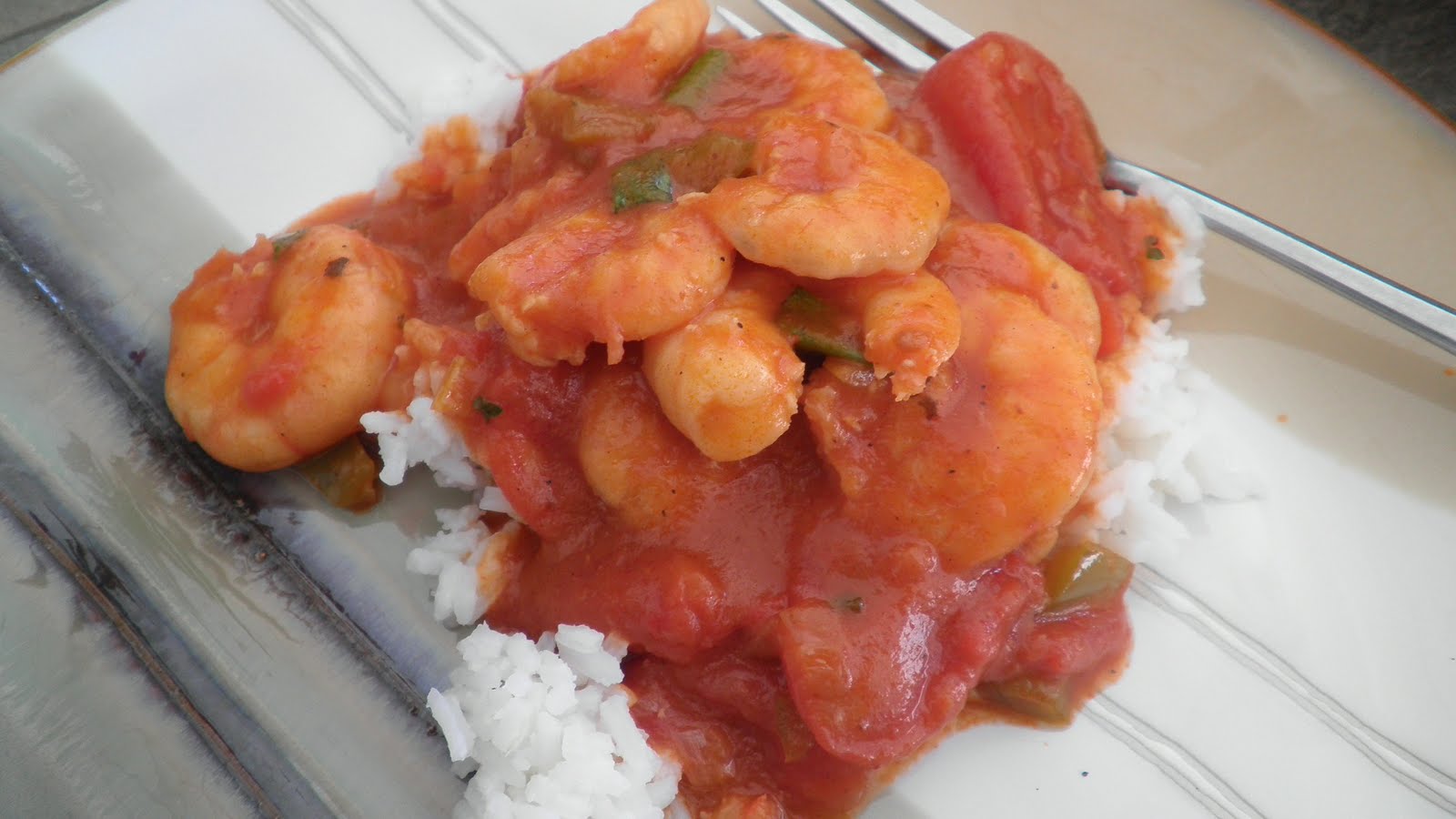
And, Shrimp Creole—shrimp in a  rich and spicy tomato sauce served over rice.  Below are two Shrimp Creole recipes—a fast one and a slow one.  The heat of both can be adjusted with hot sauce, preferably Crystal,which has more of a tomato-vinegar taste, or Tabasco, which is more "pure heat."

For either recipe I try to buy wild-caught shrimp.  Unfrozen and unpeeled have the most flavor, but they do require more prep time.  I usually buy 31-40 count (pieces per pound) shrimp so there are more bites per mouthful. 


Speedy Shrimp Creole

Source:  original recipe

Yield:  2 servings

Ingredients:

1-2 T. olive oil
1 small onion, chopped
2 celery stalks, chopped
½ green pepper, chopped
1 can Rotel Original® tomatoes, undrained
2 c. water to start
1 T. tomato paste*
½  tsp. oregano
½  tsp. thyme
Tabasco or other hot sauce, to taste
salt and pepper, to taste
1 lb. medium shrimp, peeled & deveined

*I always freeze leftover tomato paste in tablespoon dollops on a baking sheet and then store those in a freezer bag in the freezer to add to recipes such as this.

Process:

Heat the oil in a large frying pan on medium heat.  Add the onion, celery and green pepper, and sauté until soft.  Add the tomatoes, tomato paste, water and seasonings.  Simmer for 15-20 minutes, adding more water if necessary.  Add the shrimp and cook until the shrimp are opaque.  Serve with cooked rice.


Slow Shrimp Creole

This recipe takes a while—allow at least two hours.  But the result has, as they say in “chef speak,” depth of flavor.  So many south Louisiana recipes begin with the instructions “First, you start with a roux” that many of them don’t even bother to explain how you make a roux.  It’s not a complicated process—just non-stop, vigilant stirring.  

I know there are jarred store-bought roux mixes that people say are very good, but there is something rewarding, almost therapeutic, about stirring the roux constantly for about a half-hour to get that wonderful, nutty base.

Source:  adapted from an old clipping from The Advocate (Baton Rouge newspaper)

Yield:  10 generous servings

Onions, bell pepper, and celery:  the  "holy trinity" of Cajun cuisine
Ingredients:

½ c. flour
½ c. oil
2 c. chopped onions
1 c. chopped celery
½ c. chopped green pepper
2-3 cloves garlic, chopped
2 (14-oz.) cans stewed tomatoes, undrained
5-6 c. water
1 T. Crystal Hot Sauce
2 T. Worcestershire sauce
 2 t. salt (instead of the salt and peppers I used 2 tsp. Tony Chachere’s Creole Seasoning)
¼ t. red pepper
½ t. black pepper
½ t. oregano
½ t. thyme
2 ½ t. sugar
2 lbs. peeled raw medium-size shrimp (I sometimes use 3 lbs.)
2 T. chopped parsley
2 T. chopped green onion tops

Process:

(Be sure to chop the vegetables before you start the roux.)  Make a roux of flour and oil. (Translation for Yankees:  Combine the flour and oil in a large, heavy pot.  Stir constantly over low heat, about 25 minutes for this recipe.)  

When the roux is browned to a dark caramel color, add onions, celery, bell pepper, and garlic and cook until soft, stirring to prevent sticking and to coat the vegetables evenly with the roux.  Add tomatoes and tomato paste.  Mix well and cook about 5 minutes.  Then add 5 cups water.  Let simmer for 5 minutes then add seasonings and sugar.  Stir and taste.  Simmer for 1 hour.  Add shrimp and cook until opaque.  Add parsley and green onion tops and cook for about 5 minutes. Serve over rice.


Friday, March 25, 2011

Coquette

One of the great benefits of having a daughter in college in New Orleans is that we have an excuse to drive there at the drop of a hat for meals, especially to celebrate her special days, such as her twenty-second birthday. 

For this occasion, we ate at Coquette at 2800 Magazine Street.  This is a restaurant I’ve been hearing about for a few years.  Chef Mike Stolzfus worked at Restaurant August before opening Coquette in December of 2008 and was nominated this year as a “People’s Best New Chef (Gulf Region)” by Food & Wine Magazine. 

Reservations at 1:30 on a Saturday were necessary, and we were seated in the filled-to-capacity front downstairs dining room that “ells” around the inviting bar.   Waiting to be seated, our daughter expressed our feelings about dining in the Crescent City when she said, “I love that in New Orleans you can get really ‘high end’ food in a comfortable setting.”  I couldn’t have put it better myself. 

Our first impression of Coquette was the wonderful cocktail menu which includes a solid wine list and both classic and original concoctions.  My husband chose the quintessential New Orleans cocktail, the Sazerac (with absinthe), while my daughter chose the restaurant’s Coquette Collins, an inventive twist on a Tom Collins.

Coquette also features drinks that contain “house infusions.”   When I asked our waiter about the bacon bourbon, not only did he explain the brewing process, but he brought us a small sample—which tasted like a wonderfully smoky single malt Scotch.

O.K. this has to be one of the fine dining bargains in New Orleans:  a three course lunch menu for $20! 

There were three choices per course, and our waiter told us that while some items are offered consistently, many change daily.   

The first course options included a gumbo and a salad with a crispy pig ear and soft-boiled egg, which my husband seriously considered as his choice.  Ultimately, we all picked the Roast Oysters which consisted of four generous roasted oysters nestled in rock salt and topped with a fennel and bacon ragout and horseradish cream.  Observing the number of plates of this appetizer that were whisked by us during our meal, this dish is deservedly a house favorite.

For our second course, we each selected a different entrée.  My husband chose the pork belly which was somewhat of an Asian dish.  The several slices of crispy sautéed pork belly were served to be wrapped in pieces of Bibb lettuce with pickled vegetables and dipped in a spiced yogurt sauce.   The small taste he allowed me was fantastic.

My daughter chose the Gulf Shrimp with grits, a classic presentation enhanced with cippolini onions and fennel.  The dish was generous and delicious. 

I chose the Ricotta Gnocchi.  Not only were the gnocchi feather-light, but the sweetness of the diced butternut squash played off the saltiness of the chopped  Benton’s country ham in the brown butter sauce nicely.

The dessert course found us two-against-one.  My husband and daughter chose the beignets.  These were four or five round and puffy beignet, sprinkled with powdered sugar.  There were two small dipping “pots,” one of a fluffy chocolate-coffee pot de crème and the other of a caramel sauce.  I chose the panna cotta which was topped with slices of blood orange and a small dice of candied fennel—an unusual, but refreshing combination.

In a “foodie” city like New Orleans, Coquette is definitely a serious, but accessible, contender. 

Tuesday, February 15, 2011

Valentine's Day

Since I was totally indulged on my birthday weekend (see previous two blogs), I felt I owed the love of my life a very good Valentine’s Day dinner. And what man doesn’t love a steak and baked potato meal? But it had to be the BEST steak and baked potato meal.

After dinner, my husband encouraged me to continue perfecting this meal, but I’m thinking that he said this not because this was “sub-par” but because he wants more of the same! So, ladies, I’m pretty sure that this is the way to your man’s heart.

Pimento Cheese & Crackers

O.K. I know you are shaking your heads. But my husband, being a proper Southern gentleman, LOVES pimento cheese and, oddly enough, does not like it homemade. So I bought some “store-bought” pimento cheese from our Baton Rouge family-owned grocery store, Calandro’s, and served it with crackers.

Steakhouse Steaks

This recipe is from How Easy is That?, the latest cookbook from my favorite cooking “guru,” Ina Garten. If there were only this one recipe in the cookbook, it would have been worth the price. These are the most perfect steaks ever cooked in a real home. Don’t ever grill a steak again. I’m not kidding.

Source: adapted from Ina Garten’s How Easy is That?

Yield: 2 servings

Ingredients:

2 filet mignon steaks, tied (I’m not sure this is necessary) 8-10 oz. each
1 T. olive oil
½ T. fleur de sel or kosher salt (see below)
1 T, coarsely cracked black peppercorns
2 T. unsalted butter, at room temperature

Process:

Preheat oven to 400°. Heat a large cast-iron skillet over high heat for 5 to 7 minutes. Meanwhile, pat dry the filets mignon with paper towels. Brush the filets lightly all over with the oil. Combine the fleur de sel and cracked pepper on a plate and roll the filets on all sides in the mixture, pressing lightly to help the salt and pepper adhere. The steaks should be evenly coated with the salt and pepper. (I have cut the salt by half as I found the proportion a bit salty. Fleur de sel is pretty expensive, so using kosher salt would be a good substitute. But table salt is too salty.)

When the pan is extremely hot, add the steaks and sear evenly on all sides for about 2 minutes per side. (Be sure the cooking area is well ventilated.) You will need about 3 turns to sear the sides and about 10 minutes total. Remove the pan from the heat and arrange all the filets flat in the pan. Top each with a tablespoon of butter, then place the pan in the oven. Cook the filets for 8 to 12 minutes to 120 degrees for rare and 125 degrees for medium-rare. Remove the steaks to a patter, cover tightly with aluminum foil, and allow to rest for 5 to 10 minutes. (Don’t neglect this step!) Remove the string and serve.

Baked Potato with Accompaniments

I served my husband a baked potato with garnishes of crème fraiche, chopped chives, and freshly shredded Cheddar cheese. The only thing missing was bacon, but I had to draw the line somewhere.

Brandied Mushrooms

Source: original recipe

Yield: 2-4 servings

Ingredients:

1 lb. button mushrooms, sliced in ¼ -inch slices
1-2 T. butter
Salt and pepper
¼ c. brandy

In a non-stick skillet, melt the butter over medium-high heat. Add the mushrooms, sprinkle with salt and pepper, and sauté until tender and lightly browned. At this point the mushrooms can be kept off the heat. Before serving, reheat the mushrooms and add the brandy to deglaze the pan. Continue cooking until the brandy reduces to a glaze. Serve immediately.

Roasted Yellow Squash, Zucchini and Onions

Yield: 4 servings

Source: original recipe

Ingredients:

2 yellow squash, sliced in ¼ -inch slices
2 zucchini, sliced in ¼-inch slices
1 large onion, halved crosswise, then sliced lengthwise in ¼-inch slices
1 T. olive oil
Kosher salt & freshly ground pepper

Process:

Preheat oven to 425°. Place the vegetables on a large baking sheet. Drizzle with the olive oil and sprinkle with the salt and pepper. Mix the vegetables until coated with the oil and seasonings. Bake for 45-60 minutes, stirring occasionally, until tender and browned around the edges.

Red Velvet Cake

I didn’t make it ,and I didn’t serve it. While I bought a “serving” from Calandro’s, we were too full to eat dessert! But it is the perfect Valentine’s Day meal.  Maybe next year.

Saturday, February 12, 2011

Salú -- New Orleans

This site at 3226 Magazine Street has been home to several restaurants, most recently an Italian bistro that we enjoyed, but its latest incarnation as Salú, a small plate and wine bar, is its best, in my opinion. 

The décor is pleasant and tasteful. Along one wall is a long banquet, and this wall has several large mirrors hung at a downward angle that bring a lot of light and character into the space.

The tables are all covered by the obligatory paper squares, but underneath the paper are gold, royal blue, and crimson cloth tablecloths grouped in three sections in the restaurant.

This color scheme is repeated in the art work on the walls but most strikingly by the large, framed glass disk that is mounted on the ceiling. This blue circle is covered with smaller red and gold shapes so that it looks like a large and luminescent pizza. I guess it looks better than it sounds.

The menu has 5 categories: sopa y ensalada (soups and salads), frio (cold tapas), caliente (hot tapas), paella, and dulche (desserts). The list of dishes in the two tapas categories are the most extensive.

For our late afternoon lunch, we chose 3 “frio” dishes.

First, we ordered the “Deconstructed Beef Tartare.” The beef was very coarsely chopped, not at all near ground. On the plate were small “piles” of roasted peppers, capers, chopped eggs, diced onions, and a “smear” of a mustard sauce. The dish was served with a small pottery dish of crostini. Rich and tasty, this actually might have been enough for us. But we’ve never been into moderation.

Our second dish was white wine poached mussels with a roasted pepper coulis. This was a very generous bowl of tasty mussels drizzled with the roasted pepper sauce. I think I prefer hot mussels to cold, but it was a good choice nonetheless.

Our third dish was the charcuterie and cheese plate. The ingredients, artfully arranged on a “slice” of wood resembling a cross-section of a small tree, consisted of substantial wedges of bleu, brie and, my favorite, Manchego cheese. There were two rolls of salami wrapped around chorizo. Grapes and olives were also part of the presentation. O.K. This might have been enough, too.

With a great wine list and free parking available in the nearby bank parking lot, this will be a place we will definitely be returning to.