Beginning

I am a gourmand, not a gourmet, a food lover, not a food snob.
I hope to share my love of food with you through narratives, restaurant recaps,
menu suggestions, and recipes. Bon appetit!
(And if you blog about food, are you "flogging"?)

Monday, June 27, 2016

Eating in Africa

Words cannot describe the amazing experience of our recent two-week photographic safari in Kenya and Tanzania.  In fact, even though my husband and I each took hundreds of photos, they don’t really do it justice either.

However, I’d like to give you a “taste” of our adventures by focusing on a few of the more memorable meals enjoyed by the animals and the humans.  (Warning:  This is a rather long post.  Get a snack.  Pace yourself.)

The Herbivores

In the grazer category, we admired the graceful bounding of herds of gazelles, elands, antelopes, topis and other deer-like animals.  The herds of Cape buffalo, with the profile of their horns resembling a 1960s “flip” hair-do, were captivating as well.   
Cape buffalo
Impressive in terms of sheer numbers were the thousands of zebras and wildebeests we saw.  Sometime in July, these animals will begin gathering for their “great migration” from the seasonally grazed-out plains of the Serengeti  in Tanzania north to the lush grass of the Maasai Mara in Kenya.  

Our guide estimated that approximately 3 million wildebeests and 1 million zebras will embark on this treacherous journey (along with other herbivores) and many will fall victim to lions, leopards, cheetahs, and especially crocodiles when the herds must cross the croc-infested Mara River.
Zebras on the move


A grazing wildebeest
Here are a few of our favorites in the browser category, those who dine mainly on the vegetation above the grass line, such as bushes, trees, fruits, etc.  Included in this “guest list” is my husband’s favorite animal, the wart hog.
A giraffe reaches for a tasty leaf with his tongue
An olive baboon
A warthog.  So ugly, he's cute.

The Carnivores

Although the dining habits of the meat eaters are  a little more "raw" (literally), observing these animals partaking of their natural prey was breathtaking. (Trigger warning:  There are blood and guts in the following pictures.)  
Cheetahs dining on a gazelle
(Yes, that's blood on his face.)
A cheetah munching on a wart hog
A lion enjoying every last bit of a zebra
A vulture on clean-up duty

The Omnivores: Humans

Most of our meals were served buffet-style in the dining rooms of our hotels, in the lodges of our tent camps, or, once, in an actual tent itself.  

(Lest “tent camps” causes you to have visions of us huddling in a pup tent, the tents we stayed in, while made of canvas, were very large house-like structures--some bigger than any hotel rooms we’ve stayed in--with mosquito-net draped four-poster beds and other furniture and wall-enclosed bathrooms with “real” plumbing.) 

Breakfasts always featured lots of tropical fruits and juices, made-to-order omelets, and an array of side dishes.  The British influence was apparent with the inclusion of grilled tomatoes and baked beans which are often standard fare in a traditional English breakfast.

Lunches and dinners included a wide-variety of salads, entrées and desserts.  The entrées often reflected the Indian-influence on African cuisine, and curries, paneer dishes, and Indian breads. were in the regular rotation. 

I’ll admit to being slightly disappointed that either African food wasn’t more prominently featured, or, if it was, it was rather bland.  

While the Nile perch was delicious, rather flavorless and fatty roasted lamb, chicken and beef were more common, so I mostly ate vegetable dishes.  The “pasta bars,” which featured either Asian or Italian ingredients, just didn’t appeal to me. 

Following, however, are three of our more memorable meals.

Champagne Breakfast on the Maasai Mara Plains

One of the options on our tour was a hot-air balloon ride over the Maasai Mara plains. Having never been in a hot-air balloon, I found the experience exhilarating despite the 5:00 a.m. wake-up call.  

When we landed in an open field, we were treated to a champagne breakfast which included a full bar, a substantial buffet with made-to-order omelets and crepes, and a beautiful table set with linen and china.

There was even an African "port-a-potty" set up at a distance which consisted of a square box with a hole cut out in the center enclosed in a small tent.  


Carnivore

At the end of the trip, we returned to Nairobi and had lunch at the legendary Carnivore restaurant.  This is an open-air landmark that specializes in grilled meats somewhat in the Brazillian churrasco style. 

In a seemingly endless progression, waiters served us from skewers of leg of lamb, beef tenderloin, pork and beef ribs,turkey, chicken livers, pork sausages, lamb sausages, and chicken wings.  

In the “exotic” category, we passed on the ox testicles but did try the ostrich meatballs and crocodile (which, yes, tasted like chicken).  The waiters only stopped bringing the meat when we laid down the small flag on our table in surrender. 


Amaica Café

Oddly enough, we had our most African meal in the Nairobi airport as we waited for our flight back home.  Amaica Café  is one of three Amaica restaurants in Nairobi which specialize in traditional African cuisine.

For an appetizer, we had tsiswa which are flying termites roasted in a dry pan with salt.  We had heard from our tour guide that these are a delicacy and very high in protein.  

They had the consistency and somewhat the taste of finely chopped or “shredded” walnuts.  Indeed tasty and protein-rich, they might have been have been a meal on their own.  The tsiswa were served with three sauces: a spicy red chili and tomato sauce, a green chili and garlic sauce, and a sweet tamarind sauce. 


For our main course, my husband and I shared obwoba which was sort of a creamy ragù of wild traditional mushrooms.  One of our side dishes was omushenye, sweet potatoes and cow peas boiled and mashed, which had the consistency of polenta and a slightly sweet taste. 

The other side was lisutasa, black night shade leaves, which had the taste and consistency of collard greens. The proprietor was so pleased with our obvious enthusiasm about our meal that she stopped by our table and even explained how termites are harvested.  

Even though it was eaten in that unrelenting glaring light that airports have, this meal really capped off an amazing trip. 

Monday, February 15, 2016

The "Perfect Food" for Valentine's Day


For as long as I’ve known him, my husband has preached the “gospel” of pineapple.   In his words, “Pineapple is the perfect food.”  He claims pineapple goes with everything.  I can’t count the number of dinner-table conversations that went something like this:

Me:  “But pineapple wouldn’t go good on tacos.” 
Him:  “Sure it would!   How about a pineapple, onion, jalapeno salsa?”

                                   Or:

Me:  “But pineapple wouldn’t go good on liver.”
Him:  “Oh yeah!   Sautéd in the pan with the onions.  Yum!”

So while this all-pineapple meal was in part intended as a gift of love to my husband on Valentine's Day, part of it was to say, "You want pineapple?  I'll give you pineapple!"

The "Perfect Food" Menu

Father's Day Cocktail
Cream Cheese, Pepper Jelly & Pineapple Heart
Cucumber, Tomato & Pineapple Salad with Asian Dressing
Panko-Crusted Pork Cutlets with Pineapple & Ginger Salsa
Roasted Sweet Potatoes & Pineapple
Pineapple Foster

Father's Day Cocktail

I'm sure someone thought of this before me, but I didn't consult a recipe when I made this for a Father's Day at our river camp.

Source:  original

Yield: one cocktail

Ingredients:

Ice
Coconut rum, such as "Malibu"
8 oz. pineapple juice
Club soda

Process:

Fill a tall glass half-way with ice cubes.  Pour in the coconut rum and pineapple juice.  Top off with club soda and stir.  Garnish with fresh pineapple.

Cream Cheese, Pepper Jelly & Pineapple Heart

Source:  original

Yield:  2-4 servings

Ingredients:

4 oz. cream cheese (approximately)
1-2 T. red pepper jelly (I used "Tabasco" brand)
2 T. minced pineapple (canned crushed, drained could be substituted)
1-2 T. minced chives
crackers for serving

Process:

Place a large piece of plastic wrap on a small plate. Place a large heart-shaped cookie cutter on the plastic wrap. Fill the cookie cutter with the cream cheese, smoothing the surface. (You can make the cream cheese heart as thin or thick as you want. Mine was about 1/2 inch.)  Chill cream cheese heart until solid. Unmold on serving plate. Spread the pepper jelly on the heart, then distribute the pineapple on top, leaving some of the pepper jelly visible. Garnish with chives. Bring to room temperature before serving as a cracker spread.

Cucumber, Tomato & Pineapple Salad
with Asian Dressing

I wanted to mix up this menu in terms of "ethnicity."  This salad has a wonderful Thai flavor.

Source:  Gourmet, June 2006

Yield: 6 servings

Ingredients:

1 large garlic clove
1/4 teaspoon salt
2 tablespoons fresh lime juice
1 tablespoon sugar
2 tablespoons vegetable oil
1 (2-inch-long) fresh serrano or chilé, minced, including seeds*
1/4 to 1/2 teaspoon Asian fish sauce
1/2 seedless, or English cucumber, halved lengthwise, then thinly sliced crosswise
1/2 pineapple, peeled, quartered lengthwise, cored, then sliced crosswise 1/4 inch thick (2 cups)*
1/2 cup coarsely chopped fresh cilantro*
1/4 cup coarsely chopped fresh mint
2 medium tomatoes (1 lb. total), cut into 1/2-inch-thick wedges*

Process:

Mince garlic, then mash to a paste with salt using side of a large heavy knife.  Whisk together lime juice and sugar in a large bowl until sugar is dissolved, then whisk in oil, garlic paste, chilé, and fish sauce (to taste). Add remaining ingredients, tossing to coat, and add salt to taste.

* Notes:  I used the jalapeño without the seeds as I didn't want to blow our heads off.  I used a little more pineapple and cut it more in 1/2-inch chunks.  I used 2 Roma tomatoes sliced in 1/2-inch slices, and then I sliced the slices in half.


Panko-Crusted Pork Cutlets with
Pineapple & Ginger Salsa

This recipe has a great Caribbean vibe to it.

Source:  Bon Appetit, June 2007

Yield:  4

Ingredients:

2 ½ cups ½-inch cubes peeled fresh pineapple
2 T.  sugar
2 tsp. minced peeled fresh ginger
¾  c. (or more) water*
½ red bell pepper, diced*
2 tsp. white wine vinegar
4 boneless pork loin chops, trimmed
2 large eggs
1 ¼ c. panko (Japanese breadcrumbs)
salt & pepper*
1 ½ tsp. ground cumin
1/3  c. (about) all-purpose flour
3 tablespoons canola oil

Process:

Stir pineapple cubes, sugar, minced ginger, and 3/4 cup water in medium saucepan over medium-high heat until mixture comes to boil. Reduce heat to medium; cover and simmer until pineapple is soft, stirring often and adding more water by ¼ cupfuls if dry, about 30 minutes. Stir in white wine vinegar.  Season pineapple salsa to taste with salt and pepper.

Meanwhile, pound pork between sheets of waxed paper to ½-inch thickness; sprinkle with salt and pepper. Whisk eggs in medium bowl to blend. Mix panko and ground cumin in another medium bowl. Place flour on plate. Dredge pork in flour; dip into beaten eggs, then turn in panko mixture to coat, pressing to adhere.  Heat oil in heavy large skillet over medium heat. Add pork and cook until cooked through, about 5 minutes per side. Serve pork with pineapple salsa.

Notes:  I found that a lot of water remained in the pan after I had cooked the pineapple, so I drained it off.  I added the red pepper for a little more texture, color and taste. I used a commercial jerk seasoning that contains salt, pepper & spices to season the pork.

Roasted Sweet Potatoes & Pineapple

Source:  Everyday Food, Dec. 2011

Yield: 4 servings

Ingredients:

2 sweet potatoes, peeled and cut into 1-inch pieces
1 medium pineapple, peeled, cored, and cut into 1-inch pieces
1 shallot, minced*
2 tablespoons vegetable oil
1/4 teaspoon cayenne pepper
Coarse salt

Process:

Preheat oven to 450 degrees. On a rimmed baking sheet, toss together sweet potatoes, pineapple, oil, and cayenne pepper.  Season with salt.  Roast until sweet potatoes and pineapple are tender and golden, 30 to 35 minutes, stirring every 10 minutes.

*Note:  I added the shallot to counter the sweetness of the potatoes and pineapple.

Pineapple Foster

This is a riff on the classic New Orleans dessert Bananas Foster which was first created in 1951 at Brennan's Restaurant.

Source:  Bon Appetit

Yield:  2 servings

Ingredients:

1 tablespoon unsalted butter
2 tablespoons dark brown sugar
2 tablespoons dark rum
Pinch of ground nutmeg
1 3/4-inch-thick slice fresh pineapple, peeled, cored, cut into chunks (I cut it smaller)
Vanilla ice cream

Process:

Melt butter and sugar in heavy medium nonstick skillet over medium heat, stirring constantly. Add rum and nutmeg and stir until very thick and syrupy, about 2 minutes. Add pineapple and stir just to heat through. Spoon pineapple and sauce over ice cream.

Note:  I doubled the sauce recipe because it sounded so good!


Wednesday, September 24, 2014

A Decadent Food Weekend: Part 3, Lunch at Drago's

After lunch at Café Degas and dinner at Brigsten’s on Friday, it is unfathomable that we would eat for the rest of the weekend, let alone that we stopped for lunch at Drago’s Seafood Restaurant on Saturday on the way out of town.  But we agreed to “go big AND go home!”

Our day-after-decadence plans originally called for brunch at Satsuma, one of my daughter’s favorite Uptown breakfast joints.  But stifling heat (at 10:00 a.m.), long lines, and a hardly-there appetite squelched those plans.

We packed up the car and abstemiously headed home.  But a few miles out of town, I started to feel “peckish,” no doubt because my stomach had been overstretched by the previous day’s indulgences.

So I contacted my BFF Siri, who speaks to me through my phone, about restaurants near us.  The list she provided included Drago’s Seafood Restaurant, a restaurant we had heard about for years but never tried, and we were less than a half of a mile from the exit that would take us there.

With Siri’s careful guidance (don’t try it on your own), we found our way to this Metarie establishment and were given a table immediately.  (Note: Drago’s does not take reservations, so a weekend night might result in a wait.)

Drago’s Restaurant, which opened in 1969, is famous for its charbroiled oysters, and as testament to their oysters’ deliciousness, the restaurant claims to serve 900 dozen a day.

In a final effort to reign in our appetites, my husband “only” ordered a dozen of them, while I ordered a simple bowl of their seafood gumbo.


The oysters were beyond compare—swimming in a garlicky and herby butter sauce and sprinkled with Parmesan.  And Drago’s redefines the term “lagniappe,” which down here in Louisiana means a little something extra.  We counted 17 oysters on this tray—woo, hoo!  Not dipping our crusty bread in the juice left in the shells would have been wasteful.


I have eaten many bowls of seafood gumbo in my 25-plus years here in Baton Rouge, and I have to rank Drago’s in my top five. The roux was rich, but not overly dark, and the soup was enriched by a nice mélange (I love that word!) of diced vegetables, instead of being sort of weirdly, to me, thickened by okra.  I would have liked a tad more seafood in the soup, but there was a decent amount of small shrimp.

We are aware that we only dipped our toes into the pool that is the menu of Drago’s. Many of the items read as standard but, no doubt, delicious fare on southern Louisiana seafood restaurants--fried seafood po-boys and seafood platters.

We will definitely return, but we will never return without ordering a dozen (ha, ha!) charbroiled oysters.

Wednesday, September 10, 2014

A Decadent Food Weekend: Part 2, Dinner at Brigsten’s


 Although five hours, a thorough tour of the New Orleans Art Museum, and an hour nap separated our lunch at Café Degas from our dinner Brigsten’s, it was a gastronomic undertaking to eat this well, not to mention this much, in one day.  We almost felt heroic when the day was done.

There are so many good restaurants in New Orleans that it’s pretty rare if we dine at one more than once. But Brigsten’s (pronounced “Brightston’s”) is the kind of restaurant you want to return to.  In fact, this was my second visit to Brigsten's.

Brigsten’s is located at 723 Dante Street in uptown New Orleans.  Dante Street is a mostly residential street, and the restaurant is situated a few blocks from where South Carrollton meets the Mississippi River.  So it, like Café Degas, is in a quiet, accessible part of town.  We had the added benefit of being able to walk to Brigsten’s from our daughter’s apartment, and we needed to burn all the calories we could before and, especially, after our wonderful meal there.

The restaurant building is an older home, and inside it’s clear which room was the home’s former porch, parlor and dining room.  The walls and beadboard wainscoting are painted a soft yellow giving the restaurant a homey but elegant feeling.  Most of the relatively few tables (reservations are most necessary) were filled, many with families of parents and college-age children who were, no doubt, returning that weekend to one of New Orleans many universities.

Worth remembering if you visit New Orleans in August is that many restaurants participate in “Coolinary New Orleans” and offer prix fixe lunch and dinner menus at greatly reduced costs. Although we ordered from the regular menu, Brigsten’s Coolinary menu sounded appetizing and offered a nice variety of dishes for $35.


For his first course, my husband ordered “Veal Sweetbreads with Potato Leek Cake, Crimini Mushrooms, Capers, & Lemon Roasted Garlic Butter.”  We both agreed that the sweetbreads were cooked very nicely, but the butter sauce was slightly salty for our tastes.

My first course, a watermelon salad that is offered seasonally, was as beautiful as it was tasty.  Three cucumber slices were placed on a small bed of arugula, and each cucumber slice was topped with a small “cylinder” of seedless watermelon.  Each of the watermelon pieces were topped with a small ball of goat cheese that was rolled in toasted nuts.  A sprinkling of curry-flavored popcorn was an original touch.  My only suggestion would be that the watermelon towers, not just the arugula, be drizzled with a balsamic vinaigrette or reduction.


For his main course, my husband ordered the “Cochon de Lait with Cornbread Dressing, Natural Pan Gravy & Cracklins.”   For those not fluent in French or not from southern Louisiana, cochon de lait means suckling pig, and this “little baby” was exceedingly tender.  My husband commented that his entrée was almost like a full Christmas meal as it included a sweet potato puree and a broccoli soufflé or gratin.


I ordered the “Broiled Gulf Fish with Crabmeat Parmesan Crust, Mushrooms, & Lemon Mousselline.”  The fish of the day was a red snapper, and it was cooked to perfection.  I do have one small complaint about the way south Louisiana restaurants, especially Creole restaurants, serve fish and that is that the fish tends to be overly “accessorized.”   Here crabmeat AND mushrooms AND sauce was just a bit too much.

Even though we were now, like my fish, “stuffed to the gills,” we threw caution and calorie-counting to the wind and ordered dessert.  My husband ordered the pecan pie which our server told us was award-winning, and it only took each of us one bite to understand why.


Most pecan pies are made of pecan halves, and the pecans “float” on top of the rich filling.  Brigsten’s pie is made of pecan pieces which allows the pecans and the filling to be more integrated.  Our server told us that the restaurant doesn’t have a freezer, so the pie would be served on a pool of caramel sauce (the 2nd for the day!) and not with ice cream.  Believe me, we did not miss the ice cream!  (Click here to view Brigsten’s recipe for this marvelous pie.)


Lured by the way name of the dessert rolled off my tongue when I said it, I admit I was suffering under a couple of illusions when I ordered “Café Au Lait Crème Crème Brûlée.”  My first illusion pertained to size. Most crème brûlées are rather small and prepared in shallow ramekins.  This version was served in a full-sized coffee cup!

My second illusion concerned, for lack of a better word, “potency.”  Most coffee-shop café au laits are at least half milk which reduces the strength of the coffee, but this brûléed version seemed quite caffeinated. Don’t get me wrong, the dessert was superb, but my full stomach and buzzing head kept me awake for quite a while.

This was another wonderful dining experience, and if I sound slightly less-than-enthusiastic, it's because decadence can be quite demanding!

Monday, September 1, 2014

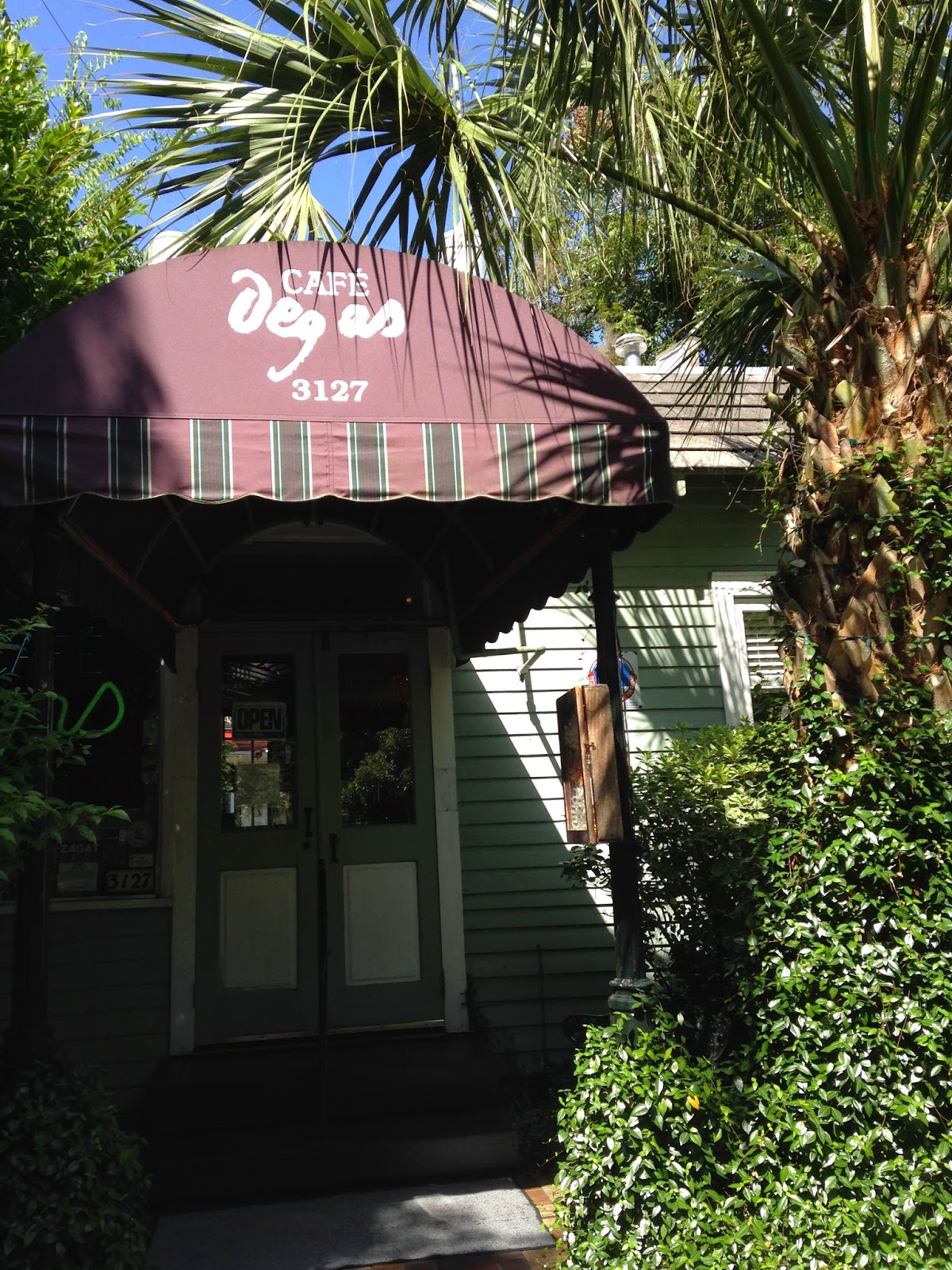
A Decadent Food Weekend: Part 1, Lunch at Cafe Degas


By happy coincidence, our daughter, who lives uptown in New Orleans, was out of town the weekend before we returned to our teaching jobs, and she offered us the use of her apartment so we could indulge in some great New Orleans eating (and a little bit of sight-seeing.)  Indulge we did!  Here, in 3 separate posts, are the restaurants we visited.

We began with a late lunch at Café Degas (3127 Esplanade Ave.) We had planned on eating light, but, as so often happens in New Orleans, those good intentions failed.


In fact, those good intentions crashed and burned immediately when we ordered an appetizer called “L’Assiette de Patés” which consisted of two incredibly rich house-made patés—a beef and a pork--and a beef-pork saucisson or sausage. Served with crusty baguette slices, these meat elements were joined on the plate by cornichons, dried figs and a fig mustard that had a great horseradish hit.   The only amount of restraint we showed at this point was in ordering a plate version of this dish instead of the larger board version.


For his lunch entrée, my husband ordered one of his favorite dishes, moules.  Café Degas’s spin on this classic French mussel dish is called “Les Moules au Fenouil," and they serve their mussels, steamed in white wine, on a bed of cooked fennel garnished with fennel fronds.  I didn’t actually get to try a mussel (ahem!), but I can vouch for the wonderful French fries, the traditional moules side dish.


I ordered “La Salade de Chèvre Tiède”  which consisted of roasted beets, Granny Smith apple slices, and toasted walnuts on an arugula salad.  Lightly dressed with a balsamic vinaigrette, the salad also featured two “warm goat cheese croutons” as they were called on the menu.  These croutons were the only weak note of the salad, as they weren’t particularly warm and were essentially crisped baguette slices smeared with goat cheese (which didn’t taste remarkably different from cream cheese).


When we ordered dessert, we salved our consciences by ordering the relatively light “île flotantte” (floating islands) which are soft meringues resting on a puddle of crème anglaise (vanilla custard.)  The “iles” were garnished with blueberries and a particularly good caramel sauce drizzle.  It was hard to restrain ourselves from licking the bowl.

Apart from the delicious food, we also loved the great location and charmingly funky atmosphere of Café Degas.  Away from the hubbub and parking nightmares of the French Quarter, Café Degas is easily accessible and on-street parking is a snap.

As you enter, a deck for outside seating is to the left. Surprisingly the inside seating, to the right, doesn’t look much different as there is a tree growing through the dining room, and the walls are sheets of clear plastic.  Since the plastic is not attached to the wall frames, I assume maybe these are rolled up in temperate weather.  But the room was surprisingly cool on this hot, humid day.

The very friendly wait staff consisted mostly of women, and tattoos seemed to be a job requirement.  But I observed something I’ve never seen in a restaurant.  As the lunch service was coming to a close and only a few customers remained, a small buffet was set up in the dining room, and the wait staff and kitchen crew sat down together in the dining room for lunch.  I am sure that goes a long way in building employee camaraderie and loyalty.

Café Degas calls itself, on its website, “The longest running and most Gallic French Bistro in New Orleans.” I can’t verify either of those claims, but we had a deliciously decadent lunch there, and I highly recommend it!

Wednesday, August 27, 2014

Sweet & Sour Summer

It's summer.  Again. Still.

For this "recovering Yankee," August pushes me to the breaking point here in Baton Rouge with the relentless heat and humidity.  

And then there's that other dreaded "H" word--hurricanes!

So it's usually around this time that I call a halt to the usual summer fare of BLTs (my favorite sandwich of all time), salads, grilled food, and restaurant meals, of course, and pretend "everything's cool."

Recently,  I cranked up the AC, the ceiling fans, and the stove vent, and stir-fried a sweet and sour pork dish that is quite a bit leaner than the usual deep-fried versions.  

Sweet and sour pork is one of my husband's favorite dishes mostly because he is religious in his conviction that pineapple is the "perfect food."  I can't count the conversations that we've had where I say, "But pineapple wouldn't go with X," and he goes all pineapple-evangelistic about how pineapple would be a wonderful compliment to X.  (Pineapple and liver?  Really?)

But I digress . . . .

A few words about woks and stir frying:

I’m no Asian cooking expert, but Asian food is one of my favorite types of cuisine and one I’ve been experimenting with for many years.

My wok is one of the best investments I’ve ever made.  It is an anodized steel stove-top model that I got from Williams-Sonoma years ago.  Anodized steel is wonderful—it is “stickless” like Teflon but doesn't require the babying that Teflon does.  And it conducts heat well. 

The problem that home cooks often have with stir frying is that most residential stoves aren’t high in BTUs.(BTU stands for British thermal units and are the units that measure the heat given off by your gas burner.) This means that it’s difficult to get a high heat that lets your ingredients, especially vegetables, get to that great crisp-tender stage.  Lower heat means there’s a risk of mushiness. 

(My dream stove will have one of those super-hot burners—and red knobs, if you know what I mean.)

I have a gas stove, so to get the maximum heat, I take off the burner grate and put the wok directly on the flame.  I crank it to high and stir away with two matching wooden spoons.  It’s the best I can do for now.

By the way, adding that pinch of salt to vegetable oil makes the “smoke point” higher.  That addition might not be necessary if you are using peanut oil, which has a higher smoke point than vegetable oil.  

So below is my "I-am-in-denial-that-it's-still-stinking-hot" meal.


Sweet and Sour Pork

Source:  original recipe

Yield:  4-6 servings (maybe 8)

Ingredients:

1 lb. pork, sliced in ½-inch X  ½-inch strips (I've used tenderloin, pork chops--anything will work)
½ c. cornstarch
vegetable or peanut oil
kosher salt 
3 carrots, thinly sliced
1-2 green peppers, sliced in thin strips
1 onion, halved crosswise, then sliced lengthwise
1-20 oz. can pineapple chunks, drained, juice reserved
¼ c. ketchup
¼ c. cider vinegar
¼ c. sugar
¼ c. soy sauce
2 T. Asian garlic chili sauce

Process:

In a small bowl, dredge the pork in the cornstarch and set aside.  In another small bowl (or 4 c. measuring cup), mix the reserved pineapple juice, ketchup, vinegar, sugar, soy sauce and chili sauce.  

In a wok on high heat, heat about 2 T. oil and a sprinkling of saltt.  When the oil is smoking, add the carrots, green peppers, and onion and stir fry until crisp-tender and slightly brown on the edges.  Add the pineapple and continuing stirring until the pineapple is brown on the edges.  Remove the vegetables and pineapple form the wok to a large serving bowl.  

Add about ¼ c. oil to the wok with a sprinkling of salt and heat until smoking.  Shake off the excess cornstarch (reserve cornstarch) from the pork and add the pork to the wok, stir frying until it is brown and cooked through.  Add the reserved vegetables and pineapple and the pineapple juice sauce to the wok and heat until boiling.  

Meanwhile mix about 1 T. of the reserved cornstarch with about ½ c. water.  Pour a small amount of this mixture at a time in to the wok to slightly think the sauce.  (You don’t want it to get pasty.)  Serve with rice.
  

Marinated Cucumber Salad

My mother used to make a salad like this that she usually served with meat loaf.  As a kid, I used to love to put the slightly-pickled onions on the meat loaf--clearly I'm of German heritage!  This salad isn't especially Asian, but rice vinegar could be substituted for the regular vinegar.  Adding a tablespoon of chopped herbs could totally change the "palette"--dill for a Scandinavian meal,  basil for an Italian or Thai meal, etc.  

Source:  my mom and various old cookbooks

Yield: 4 servings

Ingredients:

1 medium cucumber
1 small onion
½ c. vinegar
½ c. water
2 T. sugar
¼ tsp. salt
¼ tsp. pepper

Process:  

Slice the cucumbers thinly.  (You can score the cucumber with a fork lengthwise which allows the marinade to soak in more quickly and makes the cucumber slices look a bit like flowers). The onions can be sliced thinly into rings, half-moon slices or chopped.  Place the vegetables in a small bowl or plastic container.  

In a small bowl or glass measuring cup, whisk the remaining ingredients.  Pour the marinade over the vegetables and chill for at least an hour to overnight.  


Sunday, March 30, 2014

Italian Springtime Dinner


Springtime makes me think of Italy.  I’m not sure why.  Only once did we actually travel to Italy during the spring. 

To be sure, it was pretty memorable given that we were in Rome on Easter weekend, a time when tens of thousands of people flock to the city for both religious and tourist attractions.

As luck, or rather our ignorance, would have it, on Good Friday evening after dinner, we found ourselves walking back to our hotel near the Colosseum wading against the crowd of thousands of Christian pilgrims who were following the Pope in a candlelit procession from the Colosseum to the Palentine Hill to enact the Stations of the Cross, or Via Crucis. 

Maybe that is part of the reason that I think Italian when I plan a special spring meal.  So for this dinner party, held on the second day of spring, Italian food was in order with “vernal” hits of herbs, fresh asparagus and lemons. 

Since I was trying out several new recipes, including 4 originals, I did call upon some old favorites as well.  Enjoy!

Italian Spring Menu

Caprese Skewers, Melon & Prosciutto Skewers, Rosemary Cashews
My Insalate Mista
Sunday Sauce with Sausage and Braciole
Green Beans with Red Peppers & Prosciutto
Lemon Torta
Limoncello


Caprese Skewers

Who doesn’t like a caprese salad, the wonderful combination of sweet-tart tomatoes, creamy mozzarella, and the herby, licorice flavor of basil? These bight-size versions explode in the mouth!

Source:  original recipe

Yield:  6 servings

Ingredients:

¼ c. purchased pesto
¼ c. white wine vinegar
Salt & pepper to taste
¼ c. olive oil
8 oz. ciliegi mozzarella balls (If ciliegi aren’t available, buy the smallest you can and cut into cherry-sized pieces)
10.5 oz. cherry tomatoes, halved
5-6 basil leaves, cut in a chiffonade
“nice” toothpicks or short skewers

Process:

In a medium plastic container, whisk together the peso and vinegar.  Pour in the olive oil in a slow drizzle, whisking continuously.  Add salt & pepper.  (A few “shakes” of crushed red pepper flakes would be fine, too).  Stir the mozzarella balls into the pesto mixture.  Marinade, covered, for at least 2 hours.  About an hour before serving, add the halved cherry tomatoes to the mozzarella-pesto mixture.  Before serving, thread a tomato half (cut side toward the top of the skewer), a mozzarella ball, and another tomato half (cut side toward the bottom of the skewer).  Place skewers on serving plate.  Sprinkle with basil before serving.


Melon Ball & Prosciutto Skewers

Source:  original recipe

Yield:  6 servings

The combination of melon and prosciutto is a well-loved Italian classic.  My husband suggested a splash of balsamic to finish, but I thought a balsamic syrup would present more of a concentrated flavor. 

Ingredients:

1 cantaloupe or honeydew melon
1 4-oz. of prosciutto
½ c. balsamic vinegar
“nice” toothpicks or short skewers

Process:

For the balsamic syrup:  In a small sauce pan, simmer the vinegar until reduced by at least half.  Cool.  (This can be done a few hours ahead of time.)  Half the melon and clean out seeds from each half.  Scoop out the melon using the larger end of a melon baller.  (This can be done a few hours ahead of time.)

Refrigerate melon balls in a covered container.)  Cut each slice of prosciutto (can be stacked) in thirds lengthwise.  Wrap one strip of prosciutto around a melon ball and secure on a skewer.  (These can be prepared an hour or two before serving, but cover tightly with plastic wrap.)  Before serving drizzle the balsamic syrup over the skewers.  (I used a plastic squeeze bottle.)

Rosemary Cashews (see Summer (Jazz) Brunch)


My Insalate Mista

This might have been the hit of the evening.  The combination of flavors was great, and the fresh, raw asparagus was particularly spring-like.

Source:   original recipe

Yield:  6 servings

Ingredients:

Mixed greens for 6 servings (I used half baby arugula and half Boston lettuce torn into bite-size pieces.)
1 bundle asparagus, trimmed and cut into 1-inch pieces (If the asparagus is thin and tender, no cooking is necessary.  If it’s thicker, you can cook or steam the asparagus until crisp-tender, refresh in cold water, drain and pat dry.)
2-oz. sun-dried tomatoes, diced (I used packaged, not in oil and not the kind you have to reconstitute, but oil-packed drained well on paper towels would be fine.)
1 c. pine nuts, lightly toasted in a dry frying pan
1 small wedge of Asagio cheese

Process:

Lightly wash greens and dry in a salad spinner or by rolling in a clean dish towel.  Place greens in a large serving bowl.  Lightly dress the greens with some of the vinaigrette.  Place greens on each serving plate.  Sprinkle with asparagus, tomatoes, pine nuts.  Garnish with shavings of cheese.

Balsamic Vinaigrette (See Cooks, Books, and Friends)


Sunday Sauce with Sausage and Braciole

I’ll be honest, this was pretty labor intensive and the results were mixed.  First, I didn’t add the pork ribs—a little too much meat for a small dinner party.  Second, while the sauce was wonderful, the meat rolls weren’t much more than, uh, meat rolls.  Worried that they might be a little bland, I did “smear” each meat piece with some pesto, but that didn’t quite do the trick.  The breadcrumb mixture did have a good kick on the pasta, due to the smoked paprika, but it was hard to get very much of the mixture in each roulade without it “oozing” out in the rolling process.  If I made this again, I think I would skip the sausage links and instead spread a light layer of bulk Italian sausage on each piece of meat.  However, I will say the meat rolls did pick up a lot of flavor when we ate the leftovers the second day, and the sauce was outstanding!


Yield:  8 servings

Ingredients:

2 c. fresh breadcrumbs
½ c. finely grated Pecorino
⅓ c. finely chopped fresh flat-leaf parsley
1 ½ tsp. crushed red pepper flakes
¼ tsp. hot smoked Spanish paprika
7 garlic cloves, finely chopped, divided
4 T. olive oil, divided
2 pounds beef top round, thinly sliced by a butcher for braciole (¼  inch or less
Kosher salt, freshly ground pepper
2 pounds hot or sweet Italian sausage, halved crosswise
1 pound baby back pork ribs, cut into 3- to 4-rib pieces, or pork spare ribs, cut into individual ribs
1 large onion, finely chopped
2 anchovy fillets packed in oil, drained
¼ c. tomato paste
2 28-ounce cans crushed tomatoes
2 28-ounce cans whole peeled tomatoes
1 ½ pounds large tubular pasta (The recipe recommended rigatoni or tortiglioni; I used penne.)

Process:

Spread out breadcrumbs on a baking sheet and let sit uncovered at room temperature until dried out, about 12 hours.

Combine breadcrumbs, Pecorino, parsley, red pepper flakes, paprika, 1 chopped garlic clove, and 2 tablespoons oil in a medium bowl.

Trim beef slices into 6 X 2-inch pieces.  (I thought 2 inches was oddly narrow.  The pieces I used were more like 6 X 4). Season with salt and pepper. Sprinkle each slice with about 2 tablespoons breadcrumb mixture, roll up, and secure with a toothpick or twine; set braciole aside. Set remaining breadcrumb mixture aside.

Heat remaining 2 tablespoons oil in a large heavy pot over medium-high heat and cook sausage, turning occasionally, until browned on all sides, 5–8 minutes. Transfer to a large rimmed baking sheet.

Season ribs with salt and pepper; cook in same pot until browned on all sides, 8–10 minutes. Transfer to baking sheet with sausage. Cook reserved braciole in pot, turning occasionally, until browned, 5–8 minutes; transfer to same baking sheet.


Green Beans with Roasted Red Peppers & Prosciutto

Source:  original recipe

Yield:  6 servings

Ingredients:

1 ½ lbs. green beans (about a handful per person, plus one for the pot)
2 red peppers
2 T. olive oil
3-4 cloves garlic, very thinly slice
1 shake or two, crushed red pepper flakes
1 4-oz. package prosciutto, cut into ½-inch pieces

Process:

Trim the ends of green beans.  Cook green beans in salted, boiling water until crisp-tender.  Place the beans in an ice water bath to refresh.  (Can be held, refrigerated for a few hours.)

Cut the red peppers in fourths lengthwise.  Trim the tops and white ribs and remove the seeds.  Place the pepper pieces, cut side down, on a piece of aluminum foil on top of the broiler pans.  Broil peppers until the skin blackens and blisters.  Remove the peppers from the broiler and wrap and crimp the foil around the peppers.  Let the peppers steam for at least 15 minutes, then gently peel the charred skins from the peppers with your fingers.  Cut the peppers crosswise into matchstick pieces.  Set aside.

In a medium to large frying pan, sauté the prosciutto until crispy and the fat is translucent.  Drain on a paper-towel lined plate.

In a large frying pan on medium low heat, sauté the garlic (and pepper flakes if using) VERY slowly until the garlic is almost translucent, but not browned.  Remove the garlic from the pan with a slotted spoon.

(The beans, peppers and garlic oil can be prepared a few hours before serving.)

To prepare for serving, drain the beans and lightly pat dry with paper towels.  Heat the garlic oil until sizzling and stir fry the beans and peppers until heated through.  Place in a serving bowl and sprinkle with the reserved prosciutto.

Lemon Torta (See It's Greek to Me!)

Limoncello (See Drinking Italy)

I gave our dinner guests small cruets filled with limoncello, each tied with a sprig of rosemary.  (See photo at top of blog.)